Advertisements
Advertisements
Question
Visit a farm near your area. Observe and talk to the people there. Write a report.
Advertisements
Solution
One of my friends has a farm on the outskirts of the city. There is a big house at one edge of the farm. The house has a big courtyard. There is a tractor, a threshing machine, and many small farm types of equipment kept outside the house. There are 5-6 people who live permanently at my friend’s farm.
They have been working on this farm for the last many years. At present, the whole farm is full of mustard crops. It presents a beautiful landscape of yellow and green colors. There is a small orchard also on the farm. It has trees of many fruits like mango, guava, pomegranate, lemon, etc. I can also see many packets of synthetic fertilizers kept in the farmhouse. There are some jars of insecticides kept in a comer.
APPEARS IN
RELATED QUESTIONS
In your house what is done to protect grains and pulses from insects?
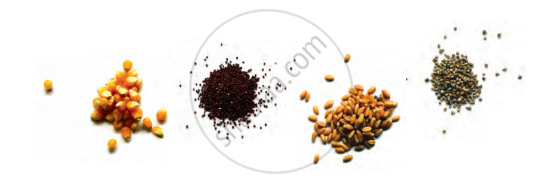
Can you recognize these grains?
The bajra seed saw differences in the way Damjibhai and Hasmukh did farming (for example, in irrigation, ploughing, etc). What were these differences?
What can happen to Hasmukh’s farm after some years?
Damjibhai’s son Hasmukh chose to become a farmer like his father. Hasmukh’s son Paresh is not a farmer, but a truck driver. Why would he have done so?
The seeds were not sure that what Hasmukh was talking about was really progress. What do you feel?
Have there been any changes near your area, which may be difficult to call ‘progress’? What changes are these? What are the different opinions about them?
What would happen if all the farmers were to use only one kind of seed and grow only one kind of crop?
What do you think is being done in the grinder (chakki) in picture 4?
What ways (technologies) would have been used to do the work shown in pictures 5 and 6? You can see that the dough is ready in picture 6. When do you think a sieve (chhalni) would have been used? Discuss each step in detail, in any language you wish to use.
