Advertisements
Advertisements
प्रश्न
Visit a farm near your area. Observe and talk to the people there. Write a report.
Advertisements
उत्तर
One of my friends has a farm on the outskirts of the city. There is a big house at one edge of the farm. The house has a big courtyard. There is a tractor, a threshing machine, and many small farm types of equipment kept outside the house. There are 5-6 people who live permanently at my friend’s farm.
They have been working on this farm for the last many years. At present, the whole farm is full of mustard crops. It presents a beautiful landscape of yellow and green colors. There is a small orchard also on the farm. It has trees of many fruits like mango, guava, pomegranate, lemon, etc. I can also see many packets of synthetic fertilizers kept in the farmhouse. There are some jars of insecticides kept in a comer.
APPEARS IN
संबंधित प्रश्न
Have you eaten roti made from bajra or jowar? Did you like these?
In your house what is done to protect grains and pulses from insects?
Which are the different festivals related to farming, celebrated in different seasons? Find out more about anyone such festival and write in your notebook –
The name of the festival, in which season is it celebrated, in which states of India, what special foods are made, is it celebrated only at home with the family, or together with many people.
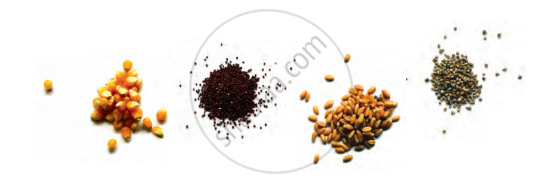
Can you recognize these grains?
The bajra seed saw differences in the way Damjibhai and Hasmukh did farming (for example, in irrigation, ploughing, etc). What were these differences?
What kind of progress would you like to see in your area?
What can happen to Hasmukh’s farm after some years?
What questions come to your mind about farmers and farming? Write some questions in your group and ask a farmer. For example, how many crops do they grow in a year? Which crop needs how much water?
There have been many changes over time, in our food. What can this mean? Use the seed story and what you know from your elders to explain.
What technology could have been used to cut the stem in picture 1?
