Advertisements
Advertisements
Question
What are wavelength, frequency, time period and amplitude of a sound wave?
Advertisements
Solution
- Wavelength: The distance between two consecutive compressions (C) or consecutive rarefactions (R) is called wavelength. The wavelength is usually represented by λ (the Greek letter lambda). Its SI unit is metre (m). Alternatively, the distance covered by a wave in one complete oscillation is called wavelength.
- Frequency: The total number of oscillations in unit time is called frequency. It is represented by v (the Greek letter nu). The SI unit of frequency is hertz. It is represented by the symbol Hz.
- Time Period: The time taken by a wave to complete one oscillation of the density of the medium is called time period (T). In other words, the time taken by two consecutive compressions or two consecutive rarefactions to pass through a given point is called the time period of the wave. Its SI unit is second (S).
- Amplitude: In wave propagation, the maximum displacement (or disturbance) of the particles of the medium on either side of the original position is called a rectangle. It is generally represented by 'A'. Its unit is the unit of pressure or density. The loudness or softness of sound is basically determined by its amplitude.
RELATED QUESTIONS
How does the loudness of sound produced depend on the vibrating area of the body ?
What type of waves are illustrated by the movement of a rope whose one end is fixed to a pole and the other end is moved up and down?
What is the vacuum? Explain why, sound cannot travel through vacuum?
Explain the terms 'crests' and troughs' of a wave? What type of waves consist of crests and troughs?
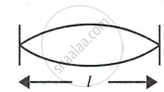
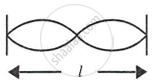
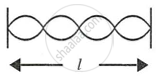
Fig. shows three ways in which a string of length l in an instrument can vibrate.
 |
 |
 |
| (i) | (ii) | (iii) |
- Which of the diagram shows the principle note?
- Which vibration has the frequency four times that of the first?
- Which vibration is of the longest wavelength?
- What is the ratio of the frequency of the vibration in (i) and (ii)?
What change do you expect in the characteristics of a musical sound if
(i) Its frequency is increased,
(ii) Its amplitude is increased?
The distance between three consecutive crests of wave is 60 cm. If the waves are produced at the rate of 180/ min, calculate:
- wavelength
- time period
- wave velocity.
Which of the following vibrates when a musical note is produced by the cymbals in a orchestra?
Vibration of object produces ______.
How does the sound produced by a vibrating object in a medium reach your ears?
