Advertisements
Advertisements
प्रश्न
What are wavelength, frequency, time period and amplitude of a sound wave?
Advertisements
उत्तर
- Wavelength: The distance between two consecutive compressions (C) or consecutive rarefactions (R) is called wavelength. The wavelength is usually represented by λ (the Greek letter lambda). Its SI unit is metre (m). Alternatively, the distance covered by a wave in one complete oscillation is called wavelength.
- Frequency: The total number of oscillations in unit time is called frequency. It is represented by v (the Greek letter nu). The SI unit of frequency is hertz. It is represented by the symbol Hz.
- Time Period: The time taken by a wave to complete one oscillation of the density of the medium is called time period (T). In other words, the time taken by two consecutive compressions or two consecutive rarefactions to pass through a given point is called the time period of the wave. Its SI unit is second (S).
- Amplitude: In wave propagation, the maximum displacement (or disturbance) of the particles of the medium on either side of the original position is called a rectangle. It is generally represented by 'A'. Its unit is the unit of pressure or density. The loudness or softness of sound is basically determined by its amplitude.
संबंधित प्रश्न
Fill in the blank.
________ produces a sensation in ears.
How is sound produced ?
You recognize your friend by hearing his voice on a telephone. Explain.
State the general name of the waves in which the particles of the medium vibrate :
(i) in the same direction as wave.
(ii) at right angles to the direction of wave.
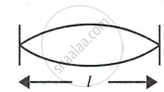
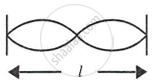
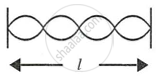
Fig. shows three ways in which a string of length l in an instrument can vibrate.
 |
 |
 |
| (i) | (ii) | (iii) |
- Which of the diagram shows the principle note?
- Which vibration has the frequency four times that of the first?
- Which vibration is of the longest wavelength?
- What is the ratio of the frequency of the vibration in (i) and (ii)?
Define the term amplitude of a wave. Write its S.I. unit.
Consider the statement given below and choose the correct option.
Assertion: When lightning strikes, the sound is heard a little after the flash is seen.
Reason: The velocity of light is greater than that of the sound.
A key of a mechanical piano struck gently and then struck again but much harder this time. In the second case
Give scientific reason.
In earlier times, people used to listen for the arrival of a distant train by putting their ear to the rail.
