Advertisements
Advertisements
प्रश्न
Draw a curve showing density or pressure variations with respect to distance for a disturbance produced by sound. Mark the position of compression and rarefaction on this curve. Also, define wavelengths and time periods using this curve.
Advertisements
उत्तर
The points of maximum density (or pressure) and minimum density (or pressure) are also called crests and troughs respectively.

Wavelength (A): The distance between two consecutive compressions or two consecutive rarefactions is called wavelength.
Time period (T): Time period of a wave is defined as the time taken by its two consecutive compressions or rarefactions to cross a fixed point.
APPEARS IN
संबंधित प्रश्न
What type of waves are illustrated by the movement of a rope whose one end is fixed to a pole and the other end is moved up and down?
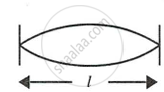
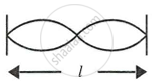
Fig. shows three ways in which a string of length l in an instrument can vibrate.
 |
 |
 |
| (i) | (ii) | (iii) |
- Which of the diagram shows the principle note?
- Which vibration has the frequency four times that of the first?
- Which vibration is of the longest wavelength?
- What is the ratio of the frequency of the vibration in (i) and (ii)?
Draw displacement-time graph of a wave and show on it the amplitude and time period of wave.
Select the correct option:
A part of the longitudinal wave in which particles of the medium are closer than the normal particles is called:
The distance between three consecutive crests of wave is 60 cm. If the waves are produced at the rate of 180/ min, calculate:
- wavelength
- time period
- wave velocity.
What is the effect of temperature and pressure on the speed of sound in a gas?
Give an example to show that light travels faster than sound?
Sound travels in air:
______ is an unwanted sound.
