Advertisements
Advertisements
Question
Advertisements
Solution
Potential energy of a body depends upon:
(i) Mass of the body
(ii) Acceleration due to gravity
(iii) Height of the body
APPEARS IN
RELATED QUESTIONS
Work done by a boy depends on the time in which he does work.
When is work said to be done by a force?
When you move upstairs, do you perform some work?
In the following case write yes, if the work is being done and no if no work is being done.
A coolie standing with a heavy load on his head
A truck driver can load oil drums into the back of the truck by pushing them up a sloping plank, or by lifting them directly. Each drum has a mass of 80 kg, the plank is 3 m long, and the back of the truck is 0.8 m above the ground.
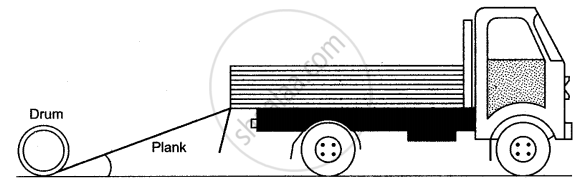
(i) How much force would be needed to lift a drum into the truck directly/without using the plank? (Take g = 10 m/s2)
(ii) How much energy would be required in lifting the drum into the truck without the plank?
(iii) If the force needed to push the drum up the plank is 300 N, why is this less than the answer to part (i)?
(iv) When the truck is loaded, the driver drives off. List the major energy changes that take place in moving the truck.
(v) The driver has to stop at the factory gates. What happens to the kinetic energy of the truck?
Calculate the work done when:
A 5 kg weight is lifted 10 m vertically. (g = 9.8 m/s2)
Look at the activity below. Reason out whether or not work is done in the light of your understanding of the term ‘work’.
Food grains are getting dried in the sun.
