Advertisements
Advertisements
Question
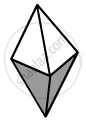
Verify Euler's formula for the following polyhedron:
Advertisements
Solution
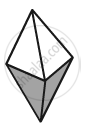
In the following polyhedron:
Edges E=8
Faces F=5
Vertices V=5
Now, putting these values in Euler's formula:
LHS: F+V
= 5 + 5
= 10
RHS: E + 2
=8+2
=10
LHS = RHS
Hence, Euler's formula is satisfied.
RELATED QUESTIONS
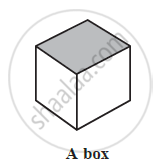
The given Figure are prisms or not?
Using Euler’s formula, find the unknown.
| Faces | ? | 5 | 20 |
| Vertices | 6 | ? | 12 |
| Edges | 12 | 9 | ? |
Can a polyhedron have 10 faces, 20 edges and 15 vertices?
What is the least number of planes that can enclose a solid? What is the name of the solid?
Can a polyhedron have 10 faces, 20 edges and 15 vertices?
Dice are cubes with dots or dots on the face. Opposite faces of a die always have a total of seven on them.
In the given below net to make dice (cube), the numbers inserted in the square indicate the number of dots in it.
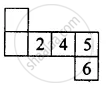
Insert suitable numbers in the blank so that numbers in opposite faces of the die have a total of seven dots.
The number of edges in a parallelogram is 4.
How many vertices does the following solid have?
Octagonal Pyramid
How many vertices does the following solid have?
Hexagonal Prism
A triangular prism has 5 faces, 9 edges and 6 vertices.
