Advertisements
Advertisements
Question
Can a polyhedron have 10 faces, 20 edges and 15 vertices?
Advertisements
Solution
\[\text { No, because every polyhedron satisfies Euler's formula, given below: }\]
\[\text { F+V=E+2 }\]
\[\text { Here, number of faces F = 10 }\]
\[\text { Number of edges E = 20 }\]
\[\text { Number of vertices V = 15 }\]
\[\text { So, by Euler's formula: }\]
\[\text { LHS: 10+15 = 25 }\]
\[\text { RHS: 20 + 2 = 22 }, \]
\[\text { which is not true because 25 }\neq22\]
\[\text { Hence, Eulers formula is not satisfied and no polyhedron may be formed .}\]
RELATED QUESTIONS
What is the least number of planes that can enclose a solid? What is the name of the solid?
Can a polyhedron have for its face 3 triangles?
Draw net for the following polyhedron :
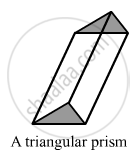
Match the following figure:
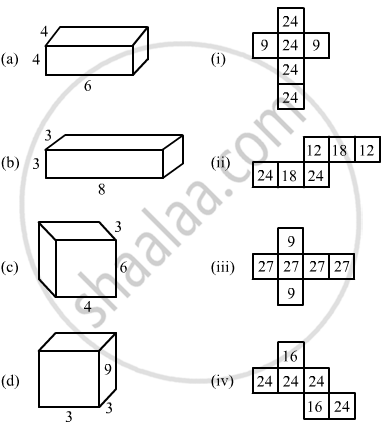
Identify if the following net can be used to form a cube:

The dimensions of a cuboid are 6 cm, 4 cm and 3 cm. Draw two different types of oblique sketches for this cuboid.
How many faces does the following solid have?
Tetrahedron
How many vertices does the following solid have?
Cone
A plane surface of a solid enclosed by edges is called ______.
A triangular prism has 5 faces, 9 edges and 6 vertices.
