Advertisements
Advertisements
Question
Vapour pressure of pure acetone and chloroform at 328 K are 741.8 mm Hg and 632.8 mm Hg respectively. Assuming that they form ideal solution over the entire range of composition, plot Ptotal, `P_"chloroform"` and `P_"acetone"` as a function of `chi_"acetone"`. The experimental data observed for different compositions of mixtures is:
| `bb(100 xx chi_"acetone")` | `bb(P_"acetone"//"mm Hg")` | `bb(P_"chloroform"//"mm Hg")` |
| 0 | 0 | 632.8 |
| 11.8 | 54.9 | 548.1 |
| 23.4 | 110.1 | 469.4 |
| 36.0 | 202.4 | 359.7 |
| 50.8 | 322.7 | 257.7 |
| 58.2 | 405.9 | 193.6 |
| 64.5 | 454.1 | 161.2 |
| 72.1 | 521.1 | 120.7 |
Plot this data also on the same graph paper. Indicate whether it has a positive or negative deviation from the ideal solution.
Advertisements
Solution
| `bb(100 xx chi_"acetone")` | `bb(P_"acetone"//"mm Hg")` | `bb(P_"chloroform"//"mm Hg")` | Ptotal (mm Hg) |
| 0 | 0 | 632.8 | 632.8 |
| 11.8 | 54.9 | 548.1 | 602.0 |
| 23.4 | 110.1 | 469.4 | 579.5 |
| 36 | 202.4 | 359.7 | 562.1 |
| 50.8 | 322.7 | 257.7 | 580.4 |
| 58.2 | 405.9 | 193.6 | 595.5 |
| 64.5 | 454.1 | 161.2 | 615.3 |
| 72.1 | 521.1 | 120.7 | 641.8 |
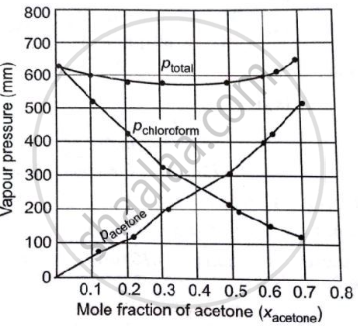
It can be observed from the graph that the plot for the Ptotal of the solution curves downward. Therefore, the solution shows a negative deviation from the ideal behaviour.
RELATED QUESTIONS
What role does the molecular interaction play in a solution of alcohol and water?
What type of intermolecular attractive interaction exists in the pair of methanol and acetone?
Which of the following concentration terms is/are independent of temperature
The observed depression in the freezing point of water for a particular solution is 0.093°C calculate the concentration of the solution in molality. Given that molal depression constant for water is 1.86 K Kg mol-1.
The rate at which a solid dissolves in liquid does not depend on ____________.
Which of the following condition is not satisfied by an ideal solution?
Why soda water bottle kept at room temperature fizzes on opening?
What is “semi permeable membrane”?
Assertion: Molarity of a solution in liquid state changes with temperature.
Reason: The volume of a solution changes with change in temperature.
Upon increase in pressure for dissociation N2O4 into NO2, equilibrium shift towards
How many times more hydrogen ions in a solution with a pH of 3 than in a solution with a pH of 6
If liquids A and B form an ideal solution, the ______.
Assertion (A): The enthalpy of mixing Δmix H is equal to zero for an ideal solution.
Reason (R): For an ideal solution the interaction between solute and solvent molecules is stronger than the interactions between solute-solute or solvent-solvent molecules.
1 mole of liquid A and 2 moles of liquid B make a solution having a total vapour pressure of 40 torr. The vapour pressure of pure A and pure B are 45 torr and 30 torr, respectively. The above solution ______.
What type of deviation from Roult’s Law is expected when phenol and aniline are mixed with each other? What change in the net volume of the mixture is expected? Graphically represent the deviation.
Suggest the most important type of intermolecular attractive interaction in the following pair.
n-hexane and n-octane
Suggest the most important type of intermolecular attractive interaction in the following pair:
I2 and CCl4
Suggest the most important type of intermolecular attractive interaction in the following pair.
NaClO4 and water
