English

Using the Property of Determinants and Without Expanding, Prove That: |(X, A, X+A),(Y,B,Y+B),(Z,C, Z+ C)| = 0 - Mathematics

Advertisements
Advertisements

Question

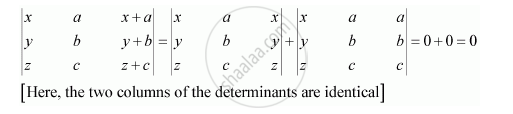
Using the property of determinants and without expanding, prove that:

`|(x, a, x+a),(y,b,y+b),(z,c, z+ c)| = 0`

Advertisements

Solution

shaalaa.com
  Is there an error in this question or solution?
Chapter 4: Determinants - Exercise 4.2 [Page 119]

APPEARS IN

NCERT Mathematics Part 1 and 2 [English] Class 12
Chapter 4 Determinants
Exercise 4.2 | Q 1 | Page 119

Video TutorialsVIEW ALL [1]

RELATED QUESTIONS

If A = `[(1,1,-2),(2,1,-3),(5,4,-9)]`, find |A|.


Find the value of x, if `|(2,4),(5,1)|=|(2x, 4), (6,x)|`.


A matrix A of order 3 × 3 has determinant 5. What is the value of |3A|?


Let A = [aij] be a square matrix of order 3 × 3 and Cij denote cofactor of aij in A. If |A| = 5, write the value of a31 C31  +  a32 C32 a33 C33.


A matrix of order 3 × 3 has determinant 2. What is the value of |A (3I)|, where I is the identity matrix of order 3 × 3.


A matrix A of order 3 × 3 is such that |A| = 4. Find the value of |2 A|.


If A is a 3 × 3 invertible matrix, then what will be the value of k if det(A–1) = (det A)k.


Which of the following is not correct?


Which of the following is not correct in a given determinant of A, where A = [aij]3×3.


If A is a matrix of order 3 and |A| = 8, then |adj A| = __________ .


Solve the following system of linear equations using matrix method: 
3x + y + z = 1
2x + 2z = 0
5x + y + 2z = 2


Show that Δ = `|(x, "p", "q"),("p", x, "q"),("q", "q", x)| = (x - "p")(x^2 + "p"x - 2"q"^2)` 


If Δ = `|(0, "b" - "a", "c" - "a"),("a" - "b", 0, "c" - "b"),("a" - "c", "b" - "c", 0)|`, then show that ∆ is equal to zero.


If x = – 4 is a root of Δ = `|(x, 2, 3),(1, x, 1),(3, 2, x)|` = 0, then find the other two roots.


If x, y ∈ R, then the determinant ∆ = `|(cosx, -sinx, 1),(sinx, cosx, 1),(cos(x + y), -sin(x + y), 0)|` lies in the interval.


The value of the determinant ∆ = `|(sin^2 23^circ, sin^2 67^circ, cos180^circ),(-sin^2 67^circ, -sin^2 23^circ, cos^2 180^circ),(cos180^circ, sin^2 23^circ, sin^2 67^circ)|` = ______.


If a + b + c ≠ 0 and `|("a", "b","c"),("b", "c", "a"),("c", "a", "b")|` 0, then prove that a = b = c.


Prove tha `|("bc" - "a"^2, "ca" - "b"^2, "ab" - "c"^2),("ca" - "b"^2, "ab" - "c"^2, "bc" - "a"^2),("ab" - "c"^2, "bc" - "a"^2, "ca" - "b"^2)|` is divisible by a + b + c and find the quotient.


If x + y + z = 0, prove that `|(x"a", y"b", z"c"),(y"c", z"a", x"b"),(z"b", x"c", y"a")| = xyz|("a", "b", "c"),("c", "a", "b"),("b", "c", "a")|`


If f(x) = `|(0, x - "a", x - "b"),(x + "b", 0, x - "c"),(x + "b", x + "c", 0)|`, then ______.


If x, y, z are all different from zero and `|(1 + x, 1, 1),(1, 1 + y, 1),(1, 1, 1 + z)|` = 0, then value of x–1 + y–1 + z–1 is ______.


If A is invertible matrix of order 3 × 3, then |A–1| ______.


If f(x) = `|((1 + x)^17, (1 + x)^19, (1 + x)^23),((1 + x)^23, (1 + x)^29, (1 + x)^34),((1 +x)^41, (1 +x)^43, (1 + x)^47)|` = A + Bx + Cx2 + ..., then A = ______.


If A and B are matrices of order 3 and |A| = 5, |B| = 3, then |3AB| = 27 × 5 × 3 = 405.


If A, B, and C be the three square matrices such that A = B + C, then Det A is equal to


`abs ((1 + "a", "b", "c"),("a", 1 + "b", "c"),("a", "b", 1 + "c")) =` ____________


The value of the determinant `abs ((1,0,0),(2, "cos x", "sin x"),(3, "sin x", "cos x"))` is ____________.


Find the minor of the element of the second row and third column in the following determinant `[(2,-3,5),(6,0,4),(1,5,-7)]`


If `"abc" ne 0  "and" abs ((1 + "a", 1, 1),(1, 1 + "b", 1),(1,1,1 + "c")) = 0, "then"  1/"a" + 1/"b" + 1/"c" =` ____________.


Let A be a square matrix of order 2 x 2, then `abs("KA")` is equal to ____________.


Find the 5th term of expansion of `(x^2 + 1/x)^10`?


For positive numbers x, y, z, the numerical value of the determinant `|(1, log_x y, log_x z),(log_y x, 1, log_y z),(log_z x, log_z y, 1)|` is


In a third order matrix aij denotes the element of the ith row and the jth column.

A = `a_(ij) = {(0",", for, i = j),(1",", f or, i > j),(-1",", f or, i < j):}`

Assertion: Matrix ‘A’ is not invertible.

Reason: Determinant A = 0

Which of the following is correct?


Share
Notifications

Englishहिंदीमराठी


      Forgot password?
Use app×