मराठी

Using the Property of Determinants and Without Expanding, Prove That: |(X, A, X+A),(Y,B,Y+B),(Z,C, Z+ C)| = 0 - Mathematics

Advertisements
Advertisements

प्रश्न

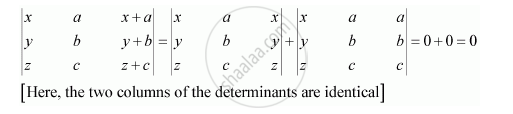
Using the property of determinants and without expanding, prove that:

`|(x, a, x+a),(y,b,y+b),(z,c, z+ c)| = 0`

Advertisements

उत्तर

shaalaa.com
  या प्रश्नात किंवा उत्तरात काही त्रुटी आहे का?
पाठ 4: Determinants - Exercise 4.2 [पृष्ठ ११९]

APPEARS IN

एनसीईआरटी Mathematics Part 1 and 2 [English] Class 12
पाठ 4 Determinants
Exercise 4.2 | Q 1 | पृष्ठ ११९

व्हिडिओ ट्यूटोरियलVIEW ALL [1]

संबंधित प्रश्‍न

Find the value of x, if `|(2,4),(5,1)|=|(2x, 4), (6,x)|`.


Let A be a square matrix of order 3 × 3, then | kA| is equal to

(A) k|A|

(B) k2 | A |

(C) k3 | A |

(D) 3k | A |


Without expanding at any stage, find the value of:

`|(a,b,c),(a+2x,b+2y,c+2z),(x,y,z)|`


Use properties of determinants to solve for x:

`|(x+a, b, c),(c, x+b, a),(a,b,x+c)| = 0` and `x != 0` 


On expanding by first row, the value of the determinant of 3 × 3 square matrix
  \[A = \left[ a_{ij} \right]\text{ is }a_{11} C_{11} + a_{12} C_{12} + a_{13} C_{13}\] , where [Cij] is the cofactor of aij in A. Write the expression for its value on expanding by second column.


If A is a 3 × 3 invertible matrix, then what will be the value of k if det(A–1) = (det A)k.


Which of the following is not correct?


Which of the following is not correct in a given determinant of A, where A = [aij]3×3.


Solve the following system of linear equations using matrix method: 
3x + y + z = 1
2x + 2z = 0
5x + y + 2z = 2


Without expanding, show that Δ = `|("cosec"^2theta, cot^2theta, 1),(cot^2theta, "cosec"^2theta, -1),(42, 40, 2)|` = 0


Show that Δ = `|(x, "p", "q"),("p", x, "q"),("q", "q", x)| = (x - "p")(x^2 + "p"x - 2"q"^2)` 


The determinant ∆ = `|(sqrt(23) + sqrt(3), sqrt(5), sqrt(5)),(sqrt(15) + sqrt(46), 5, sqrt(10)),(3 + sqrt(115), sqrt(15), 5)|` is equal to ______.


The determinant ∆ = `|(cos(x + y), -sin(x + y), cos2y),(sinx, cosx, siny),(-cosx, sinx, cosy)|` is independent of x only.


Prove tha `|("bc" - "a"^2, "ca" - "b"^2, "ab" - "c"^2),("ca" - "b"^2, "ab" - "c"^2, "bc" - "a"^2),("ab" - "c"^2, "bc" - "a"^2, "ca" - "b"^2)|` is divisible by a + b + c and find the quotient.


If x + y + z = 0, prove that `|(x"a", y"b", z"c"),(y"c", z"a", x"b"),(z"b", x"c", y"a")| = xyz|("a", "b", "c"),("c", "a", "b"),("b", "c", "a")|`


If f(x) = `|(0, x - "a", x - "b"),(x + "b", 0, x - "c"),(x + "b", x + "c", 0)|`, then ______.


If A = `[(2, lambda, -3),(0, 2, 5),(1, 1, 3)]`, then A–1 exists if ______.


If x, y, z are all different from zero and `|(1 + x, 1, 1),(1, 1 + y, 1),(1, 1, 1 + z)|` = 0, then value of x–1 + y–1 + z–1 is ______.


There are two values of a which makes determinant, ∆ = `|(1, -2, 5),(2, "a", -1),(0, 4, 2"a")|` = 86, then sum of these number is ______.


`|(0, xyz, x - z),(y - x, 0, y  z),(z - x, z - y, 0)|` = ______.


If f(x) = `|((1 + x)^17, (1 + x)^19, (1 + x)^23),((1 + x)^23, (1 + x)^29, (1 + x)^34),((1 +x)^41, (1 +x)^43, (1 + x)^47)|` = A + Bx + Cx2 + ..., then A = ______.


The maximum value of `|(1, 1, 1),(1, (1 + sintheta), 1),(1, 1, 1 + costheta)|` is `1/2`


`"A" = abs ((1/"a", "a"^2, "bc"),(1/"b", "b"^2, "ac"),(1/"c", "c"^2, "ab"))` is equal to ____________.


If A, B, and C be the three square matrices such that A = B + C, then Det A is equal to


`abs ((1 + "a", "b", "c"),("a", 1 + "b", "c"),("a", "b", 1 + "c")) =` ____________


The value of the determinant `abs ((1,0,0),(2, "cos x", "sin x"),(3, "sin x", "cos x"))` is ____________.


Find the minor of the element of the second row and third column in the following determinant `[(2,-3,5),(6,0,4),(1,5,-7)]`


If `"abc" ne 0  "and" abs ((1 + "a", 1, 1),(1, 1 + "b", 1),(1,1,1 + "c")) = 0, "then"  1/"a" + 1/"b" + 1/"c" =` ____________.


Find the 5th term of expansion of `(x^2 + 1/x)^10`?


For positive numbers x, y, z the numerical value of the determinant `|(1, log_x y, log_x z),(log_y x, 3, log_y z),(log_z x, log_z y, 5)|` is


The value of determinant `|(sin^2 13°, sin^2 77°, tan135°),(sin^2 77°, tan135°, sin^2 13°),(tan135°, sin^2 13°, sin^2 77°)|` is


Value of `|(2, 4),(-1, 2)|` is


Share
Notifications

Englishहिंदीमराठी


      Forgot password?
Use app×