Advertisements
Advertisements
Question
Two students ‘X’ and ‘Y’ perform an experiment on potentiometer separately using the circuit given below:
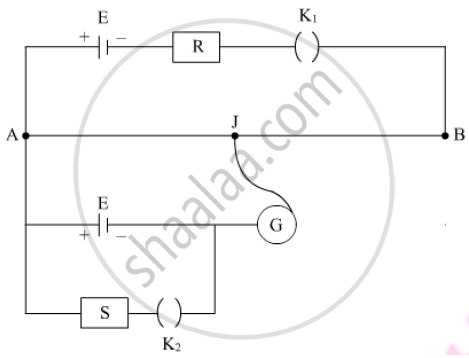
Keeping other parameters unchanged, how will the position of the null point be affected if
(i) ‘X’ increases the value of resistance R in the set-up by keeping the key K1 closed and the Key K2 opens?
(ii) ‘Y’ decreases the value of resistance S in the set-up, while the key K2 remains open and they K1 closed?
Justify.
Advertisements
Solution
(i) K1→ closed, K2→ Open
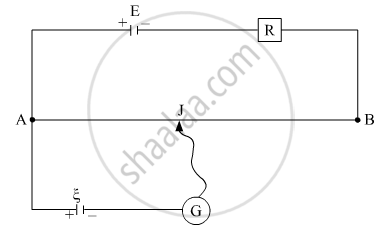
Suppose null point occurs at l,
Apply KVL in smaller loop,
ξ − l∅ = 0 …..(1)
Where, ∅ = potential drop per unit length in potentiometer wire
ξ = l∅
`=> l =xi/phi`
As X increase the value of resistance R, So, current in the circuit (wire) decrease. Hence, ∅ will be increases. Then l will decrease.
We can say, as X increases the value of R, null point decrease.
(ii) K2 → open, K1 → closed.
Then the circuit will be same as shown earlier.
We see that resistance S is not involved in the circuit because K2 is open.
So, from equation (1)
ξ = ∅l
`=> l=xi/phi`
Here, ∅ does not depends on the value of resistance S.
So, ∅ null point is not affected by decreasing the value of resistance S.
RELATED QUESTIONS
In a potentiometer experiment, the balancing length with a resistance of 2Ω is found to be 100 cm, while that of an unknown resistance is 500 cm. Calculate the value of the unknown resistance.
Define potential gradient of the potentiometer wire.
Why is a potentiometer preferred over a voltmeter for measuring emf?
A potentiometer wire is 4m long and potential difference of 3V is maintained between the ends. The emf of the cell, which balances against a length of 100 cm of the potentiometer wire is ____________.
The potentiometer is more sensitive, when ______.
Two students X and Y perform potentiometer experiment separately and null point was obtained as shown in diagram. During the experiment, ______.
- X increases the value of R (resistance)
- Y decreases the value of S (resistance)
The position of null point obtained by students X and Y respectively.

In the potentiometer experiment, cells of e.m.f. E1 and E2 are connected in series (E1 > E2). the balancing length is 64 cm of the wire. If the polarity of E2 is reversed, the balancing length becomes 32 cm. The ratio `E_1/E_2` is ______
1°C rise in temperature is observed in a conductor by passing a certain current. If the current is double then the rise in temperature is approximately.
As a cell age, its internal resistance increases. A voltmeter of resistance 270 Ω connected across an old dry cell reads 1.44 V. However, a potentiometer at the balance point gives a voltage measurement of the cell as 1.5 V. Internal resistance of the cell is ______ Ω.
In a potentiometer, a cell is balanced against 110 cm when the circuit is open. A cell is balanced at 100 cm when short-circuited through a resistance of 10 Ω. Find the internal resistance of the cell.
