Advertisements
Advertisements
Question
Two resistors R and 2R are connected in series in an electric circuit. The thermal energy developed in R and 2R are in the ratio ______________ .
Options
1 : 2
2 : 1
1 : 4
4 : 1
Advertisements
Solution
1 : 2
Thermal energy developed across a resistor,
U = i2Rt ,
where i is the current flowing through the resistor of resistance R for time t. Since the resistors are connected in series, the current flowing through both the resistors is same and the time for which the current flows is also same.
Thus, the ratio of the thermal energy developed in R and 2 R is 1 : 2.
APPEARS IN
RELATED QUESTIONS
At room temperature (27.0°C) the resistance of a heating element is 100 Ω. What is the temperature of the element if the resistance is found to be 117 Ω, given that the temperature coefficient of the material of the resistor is 1.70 × 10⁻⁴ °C−1.
A heating element using nichrome connected to a 230 V supply draws an initial current of 3.2 A which settles after a few seconds to a steady value of 2.8 A. What is the steady temperature of the heating element if the room temperature is 27.0°C? The temperature coefficient of resistance of nichrome averaged over the temperature range involved is 1.70 × 10⁻⁴ °C−1.
Draw labelled graphs to show how electrical resistance varies with temperature for:
1) a metallic wire.
2) a piece of carbon
Show variation of resistivity of Si with temperature in a graph ?
The thermal energy developed in a current-carrying resistor is given by U = i2 Rt and also by U = Vit. Should we say that U is proportional to i2 or i?
A non-ideal battery is connected to a resistor. Is work done by the battery equal to the thermal energy developed in the resistor? Will your answer change if the battery is ideal?
Sometimes it is said that "heat is developed" in a resistance when there is an electric current in it. Recall that heat is defined as the energy being transferred due to temperature difference. Is the statement in quotes technically correct?
When a current passes through a resistor, its temperature increases. Is it an adiabatic process?
An electric kettle used to prepare tea, takes 2 minutes to boil 4 cups of water (1 cup contains 200 cc of water) if the room temperature is 25°C. (a) If the cost of power consumption is Re 1.00 per unit (1 unit = 1000 watt-hour), calculate the cost of boiling 4 cups of water. (b) What will be the corresponding cost if the room temperature drops to 5°C?
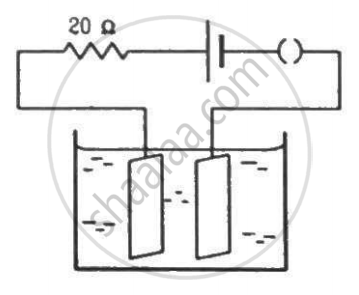
The figure shows an electrolyte of AgCl through which a current is passed. It is observed that 2.68 g of silver is deposited in 10 minutes on the cathode. Find the heat developed in the 20 Ω resistor during this period. Atomic weight of silver is 107.9 g/mol−1.
Find the thermo-emf developed in a copper-silver thermocouple when the junctions are kept at 0°C and 40°C. Use the data given in the following table.
| Metal with lead (Pb) |
a `mu V"/"^oC` |
b `muV"/("^oC)` |
| Aluminium | -0.47 | 0.003 |
| Bismuth | -43.7 | -0.47 |
| Copper | 2.76 | 0.012 |
| Gold | 2.90 | 0.0093 |
| Iron | 16.6 | -0.030 |
| Nickel | 19.1 | -0.030 |
| Platinum | -1.79 | -0.035 |
| Silver | 2.50 | 0.012 |
| Steel | 10.8 | -0.016 |
The higher and lower fixed points on a thermometer are separated by 160 mm. When the length of the mercury thread above the lower point is 40 mm, the temperature reading would be :
The specific resistance of all the metals is the most affected by ______
In metals, how does resistivity usually change when temperature increases over a limited temperature range?
Which expression gives resistance at a changed temperature?
Which microscopic relation for resistivity is given in terms of conductivity, electron mass, free-electron number density, electronic charge, and average relaxation time?
A nichrome toaster element has a resistance of \(75.3\,\Omega\) at \(27^{\circ}\mathrm{C}\) and \(85.8\,\Omega\) at its operating temperature. If \(\alpha=1.7\times10^{-4}\,^{\circ}\mathrm{C}^{-1}\), what is the steady temperature approximately?
