Advertisements
Advertisements
Question
Consider a circuit containing an ideal battery connected to a resistor. Do "work done by the battery" and "the thermal energy developed" represent two names of the same physical quantity?
Advertisements
Solution
Yes, the "work done by the battery" and "the thermal energy developed" represent two names of the same physical quantity. The work done by the battery on the resistor is dissipated by the resistor in the form of thermal energy. Hence the " work done by the battery " and " the thermal energy developed " represent two names of the same physical quantity.
However, a non-ideal battery, in this case, would have to do extra work in order to overcome the internal resistance of the battery. Hence, the work done by a non-ideal battery will not be equal to the thermal energy developed.
APPEARS IN
RELATED QUESTIONS
At room temperature (27.0°C) the resistance of a heating element is 100 Ω. What is the temperature of the element if the resistance is found to be 117 Ω, given that the temperature coefficient of the material of the resistor is 1.70 × 10⁻⁴ °C−1.
A silver wire has a resistance of 2.1 Ω at 27.5°C, and a resistance of 2.7 Ω at 100°C. Determine the temperature coefficient of resistivity of silver.
A non-ideal battery is connected to a resistor. Is work done by the battery equal to the thermal energy developed in the resistor? Will your answer change if the battery is ideal?
As the temperature of a metallic resistor is increased, the product of its resistivity and conductivity ____________ .
Is neutral temperature always the arithmetic mean of the inversion temperature and the temperature of the cold junction? Does the unit of temperature have an effect in deciding this question?
As temperature increases, the viscosity of liquids decreases considerably. Will this decrease the resistance of an electrolyte as the temperature increases?
Find the thermo-emf developed in a copper-silver thermocouple when the junctions are kept at 0°C and 40°C. Use the data given in the following table.
| Metal with lead (Pb) |
a `mu V"/"^oC` |
b `muV"/("^oC)` |
| Aluminium | -0.47 | 0.003 |
| Bismuth | -43.7 | -0.47 |
| Copper | 2.76 | 0.012 |
| Gold | 2.90 | 0.0093 |
| Iron | 16.6 | -0.030 |
| Nickel | 19.1 | -0.030 |
| Platinum | -1.79 | -0.035 |
| Silver | 2.50 | 0.012 |
| Steel | 10.8 | -0.016 |
A carbon resistor has coloured bands as shown in Figure 2 below. The resistance of the resistor is:
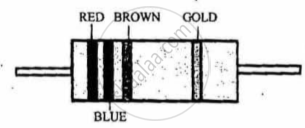
figure 2
An electrical cable of copper has just one wire of radius 9 mm. Its resistance is 5 ohm. This single copper wire of the cable is replaced by 6 different well insulated copper wires each of radius 3 mm. The total resistance of the cable will now be equal to ______.
The higher and lower fixed points on a thermometer are separated by 160 mm. When the length of the mercury thread above the lower point is 40 mm, the temperature reading would be :
Water at 10°C enters into a geyser. The water drawn out from the geyser has a temperature of 60°C and the rate of outflow of water is 18 kg/hr. The rating of the geyser is :
What does the temperature coefficient of resistivity, denoted by \(\alpha\), measure?
How is the temperature change \(\Delta T\) defined in the resistance relation?
Which microscopic relation for resistivity is given in terms of conductivity, electron mass, free-electron number density, electronic charge, and average relaxation time?
What happens to electron collisions and relaxation time in metals as temperature rises?
For metals such as copper, what is the effect of increasing temperature and the sign of \(\alpha\)?
Which linear thermometer relation is used to find the temperature \(t\) when its resistance is \(R_t\)?
