Advertisements
Advertisements
Question
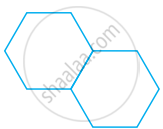
Two regular Hexagons of perimeter 30 cm each are joined as shown in the following figure. The perimeter of the new figure is ______.
Options
65 cm
60 cm
55 cm
50 cm
Advertisements
Solution
Two regular Hexagons of perimeter 30 cm each are joined as shown in the following figure. The perimeter of the new figure is 50 cm.
Explanation:
Given, perimeter of hexagon = 30 cm
And number of sides in hexagon = 6
∴ Length of one side = `"Perimeter of hexagon"/"Total number of sides"`
= `30/6`
= 5 cm
Now, two hexagons are joined then perimeter = Sum of all sides
= AB + BC + CD + DE + EF + FG + GH + HI + IJ + JA
= 5 + 5 + 5 + 5 + 5 + 5 + 5 + 5 + 5 + 5
= 50 cm
APPEARS IN
RELATED QUESTIONS
Find the perimeter of a rectangle whose length = 22.5 m and breadth = 16 dm.
Find the perimeter of each of the following closed figures:
The sides of a rectangle are 5 cm and 3 cm respectively. Find its area in mm2.
Find the shaded area in the given figure.
If a square of side 1 cm is cut out of the corner of a larger square with side 3 cm (see the figure), what will be the perimeter of the remaining shape?

Is the perimeter of the yellow shape more than the perimeter of the blue shape? Why?

A rectangle and a square have the same perimeter (Figure).

- The area of the rectangle is ______.
- The area of the square is ______.
A farmer who wants to fence his field, must find the perimeter of the field.
In an exhibition hall, there are 24 display boards each of length 1 m 50 cm and breadth 1 m. There is a 100 m long aluminium strip, which is used to frame these boards. How many boards will be framed using this strip? Find also the length of the aluminium strip required for the remaining boards.
Which unit is used to measure perimeter?
