Advertisements
Advertisements
Question
Two lines l and m intersect at the point O and P is a point on a line n passing through the point O such that P is equidistant from l and m. Prove that n is the bisector of the angle formed by l and m.
Advertisements
Solution
Given: Two lines l and m intersect at the point O and P is a point on a line n passing through O such that P is equidistant from l and m i.e., PQ = PR.
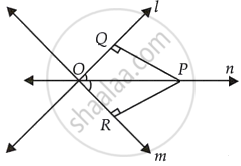
To prove: n is the bisector of the angle formed by l and m i.e., n is the bisector of ∠QOR.
Proof: In ΔOQP and ΔORP,
∠PQO = ∠PRO = 90° ...[Since, P in equidistant from l and m, so PQ and PR should be perpendicular to lines l and m respectively]
OP = OP ...[Common side]
PQ = PR ...[Given]
∴ ΔOQP ≅ ΔORP ...[By RHS congruence rule]
⇒ ∠POQ = ∠POR ...[By CPCT]
Hence, n is the bisector of ∠QOR.
Hence proved.
APPEARS IN
RELATED QUESTIONS
ABC is a right angled triangle in which ∠A = 90° and AB = AC. Find ∠B and ∠C.
ΔABC and ΔDBC are two isosceles triangles on the same base BC and vertices A and D are on the same side of BC (see the given figure). If AD is extended to intersect BC at P, show that
- ΔABD ≅ ΔACD
- ΔABP ≅ ΔACP
- AP bisects ∠A as well as ∠D.
- AP is the perpendicular bisector of BC.

AD is an altitude of an isosceles triangles ABC in which AB = AC. Show that
- AD bisects BC
- AD bisects ∠A
Two sides AB and BC and median AM of one triangle ABC are respectively equal to sides PQ and QR and median PN of ΔPQR (see the given figure). Show that:
- ΔABM ≅ ΔPQN
- ΔABC ≅ ΔPQR

BE and CF are two equal altitudes of a triangle ABC. Using RHS congruence rule, prove that the triangle ABC is isosceles.
Prove that in a quadrilateral the sum of all the sides is greater than the sum of its diagonals.
ABC and DBC are two triangles on the same base BC such that A and D lie on the opposite sides of BC, AB = AC and DB = DC. Show that AD is the perpendicular bisector of BC.
In a right triangle, prove that the line-segment joining the mid-point of the hypotenuse to the opposite vertex is half the hypotenuse.
ABCD is a quadrilateral such that diagonal AC bisects the angles A and C. Prove that AB = AD and CB = CD.
ABC is a right triangle such that AB = AC and bisector of angle C intersects the side AB at D. Prove that AC + AD = BC.
