Advertisements
Advertisements
Question
Line segment joining the mid-points M and N of parallel sides AB and DC, respectively of a trapezium ABCD is perpendicular to both the sides AB and DC. Prove that AD = BC.
Advertisements
Solution
Given: In trapezium ABCD, points M and N are the mid-points of parallel sides AB and DC respectively and join MN, which is perpendicular to AB and DC.
To prove: AD = BC
Proof: Since, M is the mid-point of AB.
∴ AM = MB
Now, in ΔAMN and ΔBMN,
AM = MB ...[Proved above]
∠3 = ∠4 ...[Each 90°]
MN = MN ...[Common side]
∴ ΔAMN ≅ ΔBMN ...[By SAS congruence rule]
∴ ∠1 = ∠2 ...[By CPCT]
On multiplying both sides of above equation by –1 and then adding 90° both sides, we get
90° – ∠1 = 90° – ∠2
⇒ ∠AND = ∠BNC ...(i)
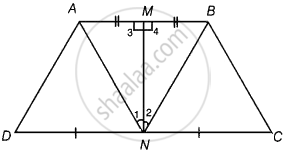
Now, in ΔADN and ΔBCN,
∠AND = ∠BNC ...[From equation (i)]
AN = BN ...[∵ΔAMN ≅ ΔBMN]
And DN = NC ...[∵ N is the mid-point of CD (given)]
∴ ΔADN ≅ ΔBCN ...[By SAS congruence rule]
Hence, AD = BC ...[By CPCT]
Hence proved.
RELATED QUESTIONS
Two sides AB and BC and median AM of one triangle ABC are respectively equal to sides PQ and QR and median PN of ΔPQR (see the given figure). Show that:
- ΔABM ≅ ΔPQN
- ΔABC ≅ ΔPQR

BE and CF are two equal altitudes of a triangle ABC. Using RHS congruence rule, prove that the triangle ABC is isosceles.
ABC is an isosceles triangle with AB = AC. Drawn AP ⊥ BC to show that ∠B = ∠C.
Prove that in a quadrilateral the sum of all the sides is greater than the sum of its diagonals.
In the following figure, BA ⊥ AC, DE ⊥ DF such that BA = DE and BF = EC. Show that ∆ABC ≅ ∆DEF.

ABC is an isosceles triangle in which AC = BC. AD and BE are respectively two altitudes to sides BC and AC. Prove that AE = BD.
Prove that sum of any two sides of a triangle is greater than twice the median with respect to the third side.
In a right triangle, prove that the line-segment joining the mid-point of the hypotenuse to the opposite vertex is half the hypotenuse.
ABCD is a quadrilateral such that diagonal AC bisects the angles A and C. Prove that AB = AD and CB = CD.
ABCD is quadrilateral such that AB = AD and CB = CD. Prove that AC is the perpendicular bisector of BD.
