Advertisements
Advertisements
Question
Two concentric and coplanar circular loops P and Q have their radii in the ratio 2:3. Loop Q carries a current 9 A in the anticlockwise direction. For the magnetic field to be zero at the common centre, loop P must carry ______.
Options
3 A in clockwise direction
9 A in clockwise direction
6 A in anti-clockwise direction
6 A in the clockwise direction
Advertisements
Solution
Two concentric and coplanar circular loops P and Q have their radii in the ratio 2:3. Loop Q carries a current 9 A in the anticlockwise direction. For the magnetic field to be zero at the common centre, loop P must carry 6 A in the clockwise direction.
Explanation:
Given: The ratio of the radius of the loops P and Q = 2:3
Current in the loop Q = 9 A in (anticlockwise direction)
To Find: The current in loop P for which the magnetic field at the common centre becomes zero.
⇒ The intensity of the magnetic field (B) at the centre of a circular current-carrying coil is given by the formula:
Magnetic Field (B) = `(μ_0i)/(2R)`
- Where 'i' is the current flowing through the circular coil.
- Here 'R' is the radius of the circular coil.
- 'μ0' is a constant known as the permeability constant of free space.
⇒ The direction of the magnetic field due to the circular current-carrying coil is given by the right-hand thumb rule.
According to this law, if we curl our right-hand palm around the current-carrying loop with fingers pointing in the direction of the current flow, then the direction of our right-hand thumb will give us the direction of the Magnetic field.
⇒ In the given question, the current in loop Q is flowing in the anticlockwise direction. Therefore for the resultant magnetic field to be zero at the common centre, the current in the loop P must flow in the clockwise direction.
Let the magnetic field due to the loop P be 'B1'
Let the magnetic field due to the loop Q be 'B2'
Let the current through the loop P be 'i1'
The ratio of the radius of the loops P and Q is R1:R2 is equal to 2:3.
⇒ The magnetic field 'B1' due to the current-carrying loop P is given by:
B1 = `(μ_0i_1)/(2R_1)` – Equation (i)
⇒ The magnetic field 'B2' due to the current-carrying loop Q is given by:
B2 = `(μ_0i_2)/(2R_2)` – Equation (ii)
⇒ Equating the equations (i) and (ii):
∵ B1 = B2
∴ `(μ_0i_1)/(2R_1) = (μ_0i_2)/(2R_2)`
∴ `i_1/i_2 = R_1/R_2`
∴ `i_1 = 2/3 xx i_2`
∴ `i_1 = 2/3 xx 9`
∴ i1 = 6 Ampere
Therefore for the magnetic field to be zero at the common centre, the loop P must carry a current of 6 Ampere in the clockwise direction.
APPEARS IN
RELATED QUESTIONS
State Ampere’s circuital law.
Obtain an expression for magnetic induction along the axis of the toroid.
Explain Ampere’s circuital law.
Consider the situation described in the previous problem. Suppose the current i enters the loop at the points A and leaves it at the point B. Find the magnetic field at the centre of the loop.
A thin but long, hollow, cylindrical tube of radius r carries i along its length. Find the magnitude of the magnetic field at a distance r/2 from the surface (a) inside the tube (b) outside the tube.
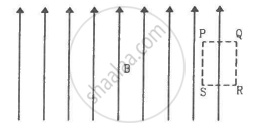
Sometimes we show an idealised magnetic field which is uniform in a given region and falls to zero abruptly. One such field is represented in figure. Using Ampere's law over the path PQRS, show that such a field is not possible.
Consider the situation of the previous problem. A particle having charge q and mass mis projected from the point Q in a direction going into the plane of the diagram. It is found to describe a circle of radius r between the two plates. Find the speed of the charged particle.
Using Ampere's circuital law, obtain an expression for the magnetic flux density 'B' at a point 'X' at a perpendicular distance 'r' from a long current-carrying conductor.
(Statement of the law is not required).
What is magnetic permeability?
