Advertisements
Advertisements
Question
Two bodies of equal masses are moving with uniform velocities v and 2v. Find the ratio of their kinetic energies.
Advertisements
Solution
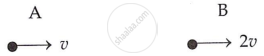
K.E = `1/2 mv^2`
K.E = `1/2 m (2v)^2`
K.E = `(1/2 mv^2) xx 4`
∴ Ratio of their K.E = `(1/2 mv^2)/(4(1/2 mv^2))`
= `1/4`
= 1 : 4
Ratio of K.E. of A and B is 1 : 4.
APPEARS IN
RELATED QUESTIONS
State two factors on which the kinetic energy of a moving body depends.
Two toy-cars A and Bof masses 200 g and 500 g respectively are moving with the same speed. Which of the two has greater kinetic energy?
A truck weighing 1000 kgf changes its speed from 36 km h-1 to 72 km h-1 in 2 minutes. Calculate:
- the work done by the engine and
- its power (g = 10 m s-2)
Two bodies have masses in the ratio 5 : 1 and their kinetic energies are in the ratio 125 : 9. Calculate the ratio of their velocities.
If the speed of a body is halved, what will be the change in its kinetic energy?
A man drops a 10 kg rock from the top of a 5 m ladder. What is its speed just before it hits the ground? What is its kinetic energy when it reaches the ground? (g = 10 m/s2)
If an object has 0 momentum, does it have kinetic energy? Explain your answer.
The energy possessed by a cricket ball bowled by a player is ______.
What is energy of motion? Give examples.
The kinetic energy of a body of mass 4 kg and momentum 6 Ns will be
