Advertisements
Advertisements
प्रश्न
Two bodies of equal masses are moving with uniform velocities v and 2v. Find the ratio of their kinetic energies.
Advertisements
उत्तर
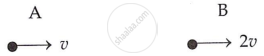
K.E = `1/2 mv^2`
K.E = `1/2 m (2v)^2`
K.E = `(1/2 mv^2) xx 4`
∴ Ratio of their K.E = `(1/2 mv^2)/(4(1/2 mv^2))`
= `1/4`
= 1 : 4
Ratio of K.E. of A and B is 1 : 4.
APPEARS IN
संबंधित प्रश्न
Write the expression for the kinetic energy of a body explaining the meaning of the symbols used.
A body of mass 10 kg is moving with a velocity 20 m s-1. If the mass of the body is doubled and its velocity is halved, find:
- the initial kinetic energy, and
- the final kinetic energy.
A body of mass 60 kg has the momentum 3000 kg m s-1. Calculate:
- the kinetic energy.
- the speed of the body.
A body is thrown vertically upwards. Its velocity keeps on decreasing. What happens to its kinetic energy as its velocity becomes zero?
What is the kinetic energy of a body of mass 1 kg moving with a speed of 2 m/s?
Two objects having equal masses are moving with uniform velocities of 2 m/s and 6 m/s respectively. Calculate the ratio of their kinetic energies.
A body of 2 kg falls from rest. What will be its kinetic energy during the fall at the end of 2 s? (Assume g = 10 m/s2)
When a ball is thrown inside a moving bus, does its kinetic energy depend on the speed of the bus? Explain.
Explain the difference between potential energy and kinetic energy.
What are the uses of mechanical energy?
