Advertisements
Advertisements
प्रश्न
Two bodies of equal masses are moving with uniform velocities v and 2v. Find the ratio of their kinetic energies.
Advertisements
उत्तर
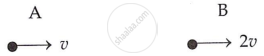
K.E = `1/2 mv^2`
K.E = `1/2 m (2v)^2`
K.E = `(1/2 mv^2) xx 4`
∴ Ratio of their K.E = `(1/2 mv^2)/(4(1/2 mv^2))`
= `1/4`
= 1 : 4
Ratio of K.E. of A and B is 1 : 4.
APPEARS IN
संबंधित प्रश्न
An object of mass, m is moving with a constant velocity, v. How much work should be done on the object in order to bring the object to rest?
The energy of a flying kite is kinetic energy.
Two toy-cars A and Bof masses 200 g and 500 g respectively are moving with the same speed. Which of the two has greater kinetic energy?
Give reasons for the following A horse and a dog are running with the same speed. Which one of them has more kinetic energy than the other.
The kinetic energy of a body is the energy by virtue of its ______.
On a level road, a scooterist applies brakes to slow down from a speed of 10 m/s to 5 m/s. If the mass of the scooterist and the scooter be 150 kg, calculate the work done by the brakes. (Neglect air resistance and friction)
A man drops a 10 kg rock from the top of a 5 m ladder. What is its speed just before it hits the ground? What is its kinetic energy when it reaches the ground? (g = 10 m/s2)
When a ball is thrown inside a moving bus, does its kinetic energy depend on the speed of the bus? Explain.
Find out the form of energy possessed by the following thing.
A rolling ball
A ball of mass 0.5 kg slows down from a speed of 10 m s−1 to that of 6 m s−1. Calculate the change in the kinetic energy of the ball.
