Advertisements
Advertisements
Question
Mention, if the following statement is True or False. If false rewrite the wrong statement in its correct form:
Adrenal gland is called Master gland.
Options
True
False
Advertisements
Solution
False
pituitary gland is called master gland.
RELATED QUESTIONS
The pituitary is called the master gland.
Short answer question
Where is the pituitary gland located? Enlist the hormones secreted by the anterior pituitary.
Sketch and label V.S of Pituitary gland.
Direction: In each of the following questions a statement of assertion (A) is given and a corresponding statement of Reason (R) is given just below it. Mark the correct statement as.
- Assertion (A): The pituitary gland is referred to as the “Master gland”.
- Reason (R): It controls the functioning of other endocrine glands.
Which of the following statements is TRUE for testosterone?
Continued secretion of milk is stimulated by
State the names of hormones and glands secreting them:
Controls tubular absorption of water in the kidney.
Distinguish between long-day and short day plants.
Mention the name of disease based on the clue/symptom given below:
Excessive growth of bones in the face, hands and feet.
The diagram given alongside shows an endocrine gland in the human body. Study the diagram and answer the following questions:
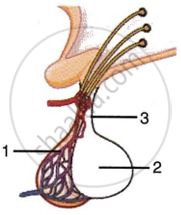 |
- Identify the gland. Write its specific location in the human body.
- Label the guidelines 1, 2 and 3 shown in the figure.
- Name any two secretions from part 1 and two from part 2.
- The deficiency of which hormone causes Diabetes insipidus? How is this condition different from Diabetes mellitus with respect to the abnormal substances present in the of urine.
