Advertisements
Advertisements
Question
To maintain one's health, a person must fulfil certain minimum daily requirements for the following three nutrients: calcium, protein and calories. The diet consists of only items I and II whose prices and nutrient contents are shown below:
| Food I | Food II | Minimum daily requirement | |
| Calcium Protein Calories |
10 5 2 |
4 6 6 |
20 20 12 |
| Price | Rs 0.60 per unit | Rs 1.00 per unit |
Find the combination of food items so that the cost may be minimum.
Advertisements
Solution
Let the person takes x units and y units of food I and II respectively that were taken in the diet.
Since, per unit of food I costs Rs 0.60 and that of food II costs Rs 1.00.
Therefore, x lbs of food I costs Rs 0.60x and y lbs of food II costs Rs 1.00y.
Total cost per day = Rs (0.60x +1.00y)
Let Z denote the total cost per day
Then, Z = 0.60x +1.00y
Since, each unit of food I contains 10 units of calcium.Therefore, x units of food I contains 10x units of calcium.
Each unit of food II contains 4 units of calcium.So, y units of food II contains 4y units of calcium.
Thus, x units of food I and y units of food II contains (10x + 4y) units of calcium.
But, the minimum requirement is 20 units of calcium.
∴ \[10x + 4y \geq 20\]
Since, each unit of food I contains 5 units of protein.Therefore, x units of food I contains 5x units of protein.
Each unit of food II contains 6 units of protein.So,y units of food II contains 6y units of protein.
Thus, x units of food I and y units of food II contains (5x + 6y) units of protein.
But, the minimum requirement is 20 lbs of protein.
∴ \[5x + 6y \geq 20\]
Since, each unit of food I contains 2 units of calories.Therefore, x units of food I contains 2x units of calories.
Each unit of food II contains 6 units of calories.So,y units of food II contains 6y units of calories.
Thus, x units of food I and y units of food II contains (2x + 6y) units of calories.
But, the minimum requirement is 12 lbs of calories.\[\therefore 2x + 6y \geq 12\]
Finally, the quantities of food I and food II are non negative values.
So,
\[x, y \geq 0\]
Hence, the required LPP is as follows:
Min Z = 0.60x + 1.00y
subject to
\[10x + 4y \geq 20\]
\[5x + 6y \geq 20\]
\[2x + 6y \geq 12\]
\[x, y \geq 0\]
First, we will convert the given inequations into equations, we obtain the following equations:
10x + 4y = 20, 5x +6y = 20, 2x + 6y =12, x = 0 and y = 0
Region represented by 10x + 4y ≥ 20:
The line 10x + 4y = 20 meets the coordinate axes at A(2, 0) and B(0, 5) respectively. By joining these points we obtain the line
10x + 4y = 20.Clearly (0,0) does not satisfies the inequation 10x + 4y ≥ 20. So,the region in xy plane which does not contain the origin represents the solution set of the inequation 10x + 4y ≥ 20.
Region represented by 5x +6y ≥ 20:
The line 5x +6y = 20 meets the coordinate axes at
\[C\left( 4, 0 \right)\] and \[D\left( 0, \frac{10}{3} \right)\] respectively. By joining these points we obtain the line
5x +6y = 20.Clearly (0,0) does not satisfies the 5x +6y ≥ 20. So,the region which does not contains the origin represents the solution set of the inequation 5x +6y ≥ 20.
Region represented by 2x + 6y ≥ 12:
The line 2x + 6y =12 meets the coordinate axes at \[E\left( 6, 0 \right)\] and \[E\left( 6, 0 \right)\] respectively. By joining these points we obtain the line
2x + 6y =12.Clearly (0,0) does not satisfies the inequation 2x + 6y ≥ 12. So,the region which does not contains the origin represents the solution set of the inequation 2x + 6y≥ 12.
Region represented by x ≥ 0 and y ≥ 0:
Since, every point in the first quadrant satisfies these inequations. So, the first quadrant is the region represented by the inequations x ≥ 0, and y ≥ 0.
The feasible region determined by the system of constraints 10x + 4y ≥ 20, 5x +6y ≥ 20, 2x + 6y ≥ 12, x ≥ 0, and y ≥ 0 are as follows.
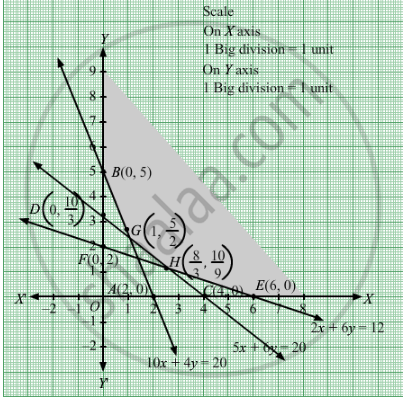
The set of all feasible solutions of the above LPP is represented by the feasible region shaded in the graph.
The corner points of the feasible region are B(0, 5), G \[\left( 1, \frac{5}{2} \right)\],H \[\left( \frac{8}{3}, \frac{10}{9} \right)\] and E \[\left( 6, 0 \right)\]
The value of the objective function at these points are given by the following table
| Points | Value of Z |
| B |
\[0 . 6\left( 0 \right) + 5 = 5\]
|
| G |
\[0 . 6\left( 1 \right) + \frac{5}{2} = 3 . 1\]
|
| H |
\[0 . 6\left( \frac{8}{3} \right) + \left( \frac{10}{9} \right) = 1 . 6 + 1 . 1 = 2 . 7\]
|
| E |
\[0 . 6\left( 6 \right) + \left( 0 \right) = 3 . 6\]
|
We see that the minimum cost is 2.7 which is at \[\left( \frac{8}{3}, \frac{10}{9} \right)\].Thus, at minimum cost, \[\frac{8}{3}\] units of food I and \[\frac{10}{9}\] units of food II should be included in the diet.
APPEARS IN
RELATED QUESTIONS
Solve the following L.P.P graphically:
Maximize: Z = 10x + 25y
Subject to: x ≤ 3, y ≤ 3, x + y ≤ 5, x ≥ 0, y ≥ 0
There are two types of fertilisers 'A' and 'B'. 'A' consists of 12% nitrogen and 5% phosphoric acid whereas 'B' consists of 4% nitrogen and 5% phosphoric acid. After testing the soil conditions, farmer finds that he needs at least 12 kg of nitrogen and 12 kg of phosphoric acid for his crops. If 'A' costs Rs 10 per kg and 'B' cost Rs 8 per kg, then graphically determine how much of each type of fertiliser should be used so that nutrient requirements are met at a minimum cost
Solve the following L. P. P. graphically:Linear Programming
Minimize Z = 6x + 2y
Subject to
5x + 9y ≤ 90
x + y ≥ 4
y ≤ 8
x ≥ 0, y ≥ 0
Solve the following LPP by graphical method:
Minimize Z = 7x + y subject to 5x + y ≥ 5, x + y ≥ 3, x ≥ 0, y ≥ 0
Solve the following LPP graphically :
Maximise Z = 105x + 90y
subject to the constraints
x + y ≤ 50
2x + y ≤ 80
x ≥ 0, y ≥ 0.
In order to supplement daily diet, a person wishes to take X and Y tablets. The contents (in milligrams per tablet) of iron, calcium and vitamins in X and Y are given as below :
| Tablets | Iron | Calcium | Vitamin |
| x | 6 | 3 | 2 |
| y | 2 | 3 | 4 |
The person needs to supplement at least 18 milligrams of iron, 21 milligrams of calcium and 16 milligrams of vitamins. The price of each tablet of X and Y is Rs 2 and Rs 1 respectively. How many tablets of each type should the person take in order to satisfy the above requirement at the minimum cost? Make an LPP and solve graphically.
Maximise z = 8x + 9y subject to the constraints given below :
2x + 3y ≤ 6
3x − 2y ≤6
y ≤ 1
x, y ≥ 0
Minimize Z = 2x + 4y
Subject to
\[x + y \geq 8\]
\[x + 4y \geq 12\]
\[x \geq 3, y \geq 2\]
Minimize Z = 5x + 3y
Subject to
\[2x + y \geq 10\]
\[x + 3y \geq 15\]
\[ x \leq 10\]
\[ y \leq 8\]
\[ x, y \geq 0\]
Minimize Z = 3x1 + 5x2
Subject to
\[x_1 + 3 x_2 \geq 3\]
\[ x_1 + x_2 \geq 2\]
\[ x_1 , x_2 \geq 0\]
Maximize Z = 2x + 3y
Subject to
\[x + y \geq 1\]
\[10x + y \geq 5\]
\[x + 10y \geq 1\]
\[ x, y \geq 0\]
Maximize Z = −x1 + 2x2
Subject to
\[- x_1 + 3 x_2 \leq 10\]
\[ x_1 + x_2 \leq 6\]
\[ x_1 - x_2 \leq 2\]
\[ x_1 , x_2 \geq 0\]
Find the minimum value of 3x + 5y subject to the constraints
− 2x + y ≤ 4, x + y ≥ 3, x − 2y ≤ 2, x, y ≥ 0.
Find graphically, the maximum value of Z = 2x + 5y, subject to constraints given below:
2x + 4y ≤ 8
3x + y ≤ 6
x + y ≤ 4
x ≥ 0, y ≥ 0
A dietician mixes together two kinds of food in such a way that the mixture contains at least 6 units of vitamin A, 7 units of vitamin B, 11 units of vitamin C and 9 units of vitamin D. The vitamin contents of 1 kg of food X and 1 kg of food Y are given below:
| Vitamin A |
Vitamin B |
Vitamin |
Vitamin D |
|
| Food X Food Y |
1 2 |
1 1 |
1 3 |
2 1 |
One kg food X costs Rs 5, whereas one kg of food Y costs Rs 8. Find the least cost of the mixture which will produce the desired diet.
Kellogg is a new cereal formed of a mixture of bran and rice that contains at least 88 grams of protein and at least 36 milligrams of iron. Knowing that bran contains 80 grams of protein and 40 milligrams of iron per kilogram, and that rice contains 100 grams of protein and 30 milligrams of iron per kilogram, find the minimum cost of producing this new cereal if bran costs Rs 5 per kg and rice costs Rs 4 per kg
One kind of cake requires 300 gm of flour and 15 gm of fat, another kind of cake requires 150 gm of flour and 30 gm of fat. Find the maximum number of cakes which can be made from 7.5 kg of flour and 600 gm of fat, assuming that there is no shortage of the other ingradients used in making the cake. Make it as an LPP and solve it graphically.
A fruit grower can use two types of fertilizer in his garden, brand P and Q. The amounts (in kg) of nirogen, phosphoric acid, potash, and chlorine in a bag of each brand are given in the table. Tests indicates that the garden needs at least 240 kg of phosphoric acid, at least 270 kg of potash and at most 310 kg of chlorine.
| kg per bag | ||
| Brand P | Brand P | |
| Nitrogen | 3 | 3.5 |
| Phosphoric acid | 1 | 2 |
| Potash | 3 | 1.5 |
| Chlorine | 1.5 | 2 |
If the grower wants to minimize the amount of nitrogen added to the garden, how many bags of each brand should be used? What is the minimum amount of nitrogen added in the garden?
A furniture manufacturing company plans to make two products : chairs and tables. From its available resources which consists of 400 square feet to teak wood and 450 man hours. It is known that to make a chair requires 5 square feet of wood and 10 man-hours and yields a profit of Rs 45, while each table uses 20 square feet of wood and 25 man-hours and yields a profit of Rs 80. How many items of each product should be produced by the company so that the profit is maximum?
A firm manufactures headache pills in two sizes A and B. Size A contains 2 grains of aspirin, 5 grains of bicarbonate and 1 grain of codeine; size B contains 1 grain of aspirin, 8 grains of bicarbonate and 66 grains of codeine. It has been found by users that it requires at least 12 grains of aspirin, 7.4 grains of bicarbonate and 24 grains of codeine for providing immediate effects. Determine graphically the least number of pills a patient should have to get immediate relief. Determine also the quantity of codeine consumed by patient.
A manufacturer makes two products A and B. Product A sells at Rs 200 each and takes 1/2 hour to make. Product B sells at Rs 300 each and takes 1 hour to make. There is a permanent order for 14 of product A and 16 of product B. A working week consists of 40 hours of production and weekly turnover must not be less than Rs 10000. If the profit on each of product A is Rs 20 and on product B is Rs 30, then how many of each should be produced so that the profit is maximum. Also, find the maximum profit.
A manufacturer of patent medicines is preparing a production plan on medicines, A and B. There are sufficient raw materials available to make 20000 bottles of A and 40000 bottles of B, but there are only 45000 bottles into which either of the medicines can be put. Further, it takes 3 hours to prepare enough material to fill 1000 bottles of A, it takes 1 hour to prepare enough material to fill 1000 bottles of B and there are 66 hours available for this operation. The profit is Rs 8 per bottle for A and Rs 7 per bottle for B. How should the manufacturer schedule his production in order to maximize his profit?
A company sells two different products, A and B. The two products are produced in a common production process, which has a total capacity of 500 man-hours. It takes 5 hours to produce a unit of A and 3 hours to produce a unit of B. The market has been surveyed and company officials feel that the maximum number of unit of A that can be sold is 70 and that for B is 125. If the profit is Rs 20 per unit for the product A and Rs 15 per unit for the product B, how many units of each product should be sold to maximize profit?
A library has to accommodate two different types of books on a shelf. The books are 6 cm and 4 cm thick and weigh 1 kg and \[1\frac{1}{2}\] kg each respectively. The shelf is 96 cm long and atmost can support a weight of 21 kg. How should the shelf be filled with the books of two types in order to include the greatest number of books? Make it as an LPP and solve it graphically.
A merchant plans to sell two types of personal computers a desktop model and a portable model that will cost Rs 25,000 and Rs 40,000 respectively. He estimates that the total monthly demand of computers will not exceed 250 units. Determine the number of units of each type of computers which the merchant should stock to get maximum profit if he does not want to invest more than Rs 70 lakhs and his profit on the desktop model is Rs 4500 and on the portable model is Rs 5000. Make an LPP and solve it graphically.
A manufacturing company makes two models A and B of a product. Each piece of model A requires 9 labour hours for fabricating and 1 labour hour for finishing. Each piece of model B requires 12 labour hours for fabricating and 3 labour hours for finishing. For fabricating and finishing, the maximum labour hours available are 180 and 30 respectively. The company makes a profit of ₹8000 on each piece of model A and ₹12000 on each piece of model B. How many pieces of model A and model B should be manufactured per week to realise a maximum profit? What is the maximum profit per week?
A medical company has factories at two places, A and B. From these places, supply is made to each of its three agencies situated at P, Q and R. The monthly requirements of the agencies are respectively 40, 40 and 50 packets of the medicines, while the production capacity of the factories, A and B, are 60 and 70 packets respectively. The transportation cost per packet from the factories to the agencies are given below:
| Transportation Cost per packet(in Rs.) | ||
| From-> | A | B |
| To | ||
| P | 5 | 4 |
| Q | 4 | 2 |
| R | 3 | 5 |
Maximize: z = 3x + 5y Subject to
x +4y ≤ 24 3x + y ≤ 21
x + y ≤ 9 x ≥ 0 , y ≥0
From the details given below, calculate the five-year moving averages of the number of students who have studied in a school. Also, plot these and original data on the same graph paper.
| Year | 1993 | 1994 | 1995 | 1996 | 1997 | 1998 | 1999 | 2000 | 2001 | 2002 |
| Number of Students | 332 | 317 | 357 | 392 | 402 | 405 | 410 | 427 | 405 | 438 |
Find the graphical solution for the system of linear inequation 2x + y ≤ 2, x − y ≤ 1
The region XOY - plane which is represented by the inequalities -5 ≤ x ≤ 5, -5 ≤ y ≤ 5 is ______
Corner points of the feasible region determined by the system of linear constraints are (0, 3), (1, 1) and (3, 0). Let Z = px + qy, where p, q > 0. Condition on p and q so that the minimum of Z occurs at (3, 0) and (1, 1) is ______.
What is called the feasible region?
What is an optimal solution?
If two corner points give the same optimum value, which points are also optimal?
