Advertisements
Advertisements
Question
There is surface area and volume of a sphere equal, find the radius of sphere.
Advertisements
Solution
Let the radius of sphere = r
∵ Volume of sphere = Surface area of sphere
`4/3` πr3 = 4 πr2
⇒ r3 = `(4 πr^2 xx 3)/4π`
⇒ r3 = 3r2
⇒ r = 3 cm
Hence, the radius of sphere = 3 cm.
RELATED QUESTIONS
A model of a ship is made to a scale 1: 300
1) The length of the model of the ship is 2 m. Calculate the lengths of the ship.
2) The area of the deck ship is 180,000 m2. Calculate the area of the deck of the model.
3) The volume of the model in 6.5 m3. Calculate the volume of the ship.
Find the surface area of a sphere of diameter 3.5 cm.
How many balls each of radius 1 cm can be made by melting a bigger ball whose diameter is 8 cm?
How many spherical bullets can be made out of a solid cube of lead whose edge measures 44 cm, each bullet being 4 cm in diameter?
If a sphere is inscribed in a cube, find the ratio of the volume of cube to the volume of the sphere.
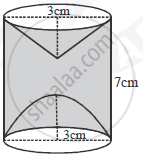
A hemispherical and a conical hole is scooped out of a.solid wooden cylinder. Find the volume of the remaining solid where the measurements are as follows:
The height of the solid cylinder is 7 cm, radius of each of hemisphere, cone and cylinder is 3 cm. Height of cone is 3 cm.
Give your answer correct to the nearest whole number.Taken`pi = 22/7`.
Find the surface area and volume of sphere of the following radius. (π = 3.14 )
3.5 cm
Find the length of the wire of diameter 4 m that can be drawn from a solid sphere of radius 9 m.
The internal and external diameters of a hollow hemi-spherical vessel are 21 cm and 28 cm respectively. Find volume of material of the vessel.
The volume of a sphere is 905 1/7 cm3, find its diameter.
