Advertisements
Advertisements
Question
The sum of adjacent angles of a parallelogram is ______.
Options
180°
120°
360°
90°
Advertisements
Solution
The sum of adjacent angles of a parallelogram is 180°.
Explanation:
By property of the parallelogram, we know that, the sum of adjacent angles of a parallelogram is 180°.
APPEARS IN
RELATED QUESTIONS
In the following figure, ABCD and PQRS are two parallelograms such that ∠D = 120° and ∠Q = 70°.
Find the value of x.
In the following figure, ABCD is a parallelogram. 
Prove that:
(i) AP bisects angle A.
(ii) BP bisects angle B
(iii) ∠DAP + ∠BCP = ∠APB
In the following figures, find the remaining angles of the parallelogram
In the following figures, find the remaining angles of the parallelogram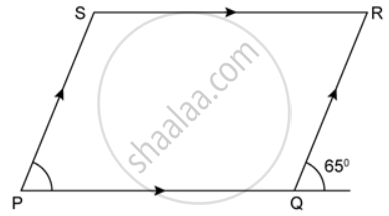
Find the measures of all the angles of the parallelogram shown in the figure: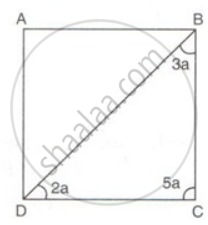
The angles of a triangle formed by 2 adjacent sides and a diagonal of a parallelogram are in the ratio 1 : 5 : 3. Calculate the measures of all the angles of the parallelogram.
PQR is a triangle formed by the adjacent sides PQ and QR and diagonal PR of a parallelogram PQRS. If in ΔPQR, ∠P : ∠Q : ∠R = 3 : 8 : 4, Calculate the measures of all the angles of parallelogram PQRS.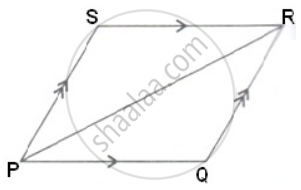

Opposite angles of a quadrilateral ABCD are equal. If AB = 4 cm, determine CD.
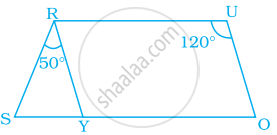
In the given parallelogram YOUR, ∠RUO = 120° and OY is extended to point S such that ∠SRY = 50°. Find ∠YSR.