Advertisements
Advertisements
Question
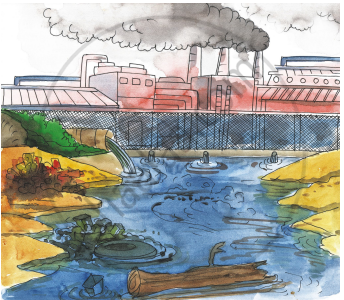
The residents of Kanpur decide to approach the Chairman of the Municipal Steps which can be taken problem of pollution in their city. In groups of six, play the role of the following : (Cue cards may be given by the teacher)
• A farmer
• An environmentalist
• Chairman of the Municipal Corporation
• President of 'Save the Ganga Project'
• A Human rights activist
Advertisements
Solution
- A farmer: The water which comes to our fields from the Ganges is very dirty. It looks blackish with a layer of oil on top. I think all of this is due to the tanneries near the river. Over last five years the yield from my field has gone down sharply. I am worried how I shall provide food to my family.
- An environmentalist: The water of the Ganges is highly polluted with effluents from tanneries and other factories. The smoke from these factories is polluting the air with harmful gases as well. Nothing is safe, neither air nor water. Drinking water is full of harmful substances like arsenic. There has been a sharp rise in the number of cases of asthma and gastric problems. The fish population is decreasing in the Ganges which is a sign of ecological imbalance.
- President of ‘Save the Ganga Project’: The Ganga is not only a sacred river but it is the only source to sustain life in Kanpur also. It is ridiculous that on die one hand we worship Ganga and on the other we go on making it a dirty and filthy river.
- A Human rights activist: Children are exploited by greedy factory owners. There should be strict punishment for factory owners as they make innocent children toil in harsh and polluted environment.
APPEARS IN
RELATED QUESTIONS
Why did the women at the temple discuss the latest episode of ‘Kashi Yatre’?
Here are some direct quotations from the story. Identify the speaker and write what each quotation suggests about the speaker. You can use the adjectives given in the box and may also add your own.
| amiable, tender, gentle, sympathetic, understanding, determined, diligent, kind, concerned, systematic, wise, helpful, enthusiastic, selfish, cruel, humble, religious, prudent |
| Speaker | Quotation | Quality Highlighted | |
|
a. |
'Avva, is everything all right? Are you O.K.?' |
||
| b. | 'At times, I used to regret not going to school, so I made sure that my children and grandchildren studied well.' |
||
| c. | 'Avva, don't cry. What is the matter? Can I help you in anyway?' |
||
| d. | 'We are well-off, but what use is money when I cannot be independent.' | ||
| e. | 'I will keep Saraswati Pooja day during Dassara as the deadline.' | ||
| f. | 'For a good cause if you are determined you can overcome any obstacle.' | ||
| g. | I am touching the feet of a teacher not my granddaughter.' |
Answer the following questions briefly:
(a) In 1953, Hooper was a favoured young man. Explain.
(b) They said that they would create a desk job for Hooper at headquarters.
- Who are ‘they’?
- Why did they decide to do this?
(c) Duke was an extraordinary dog. What special qualities did he exhibit to justify this? Discuss.
(d) What problems did Chuck present when he returned to the company headquarters?
(e) Why do you think Charles Hooper’s appointment as Assistant National Sales Manager is considered to be a tribute to Duke?
Answer the following question briefly:
Private Quelch looked like a ‘Professor’ when the author first met him at the training depot. Why?
Answer the following question briefly:
How did Private Quelch manage to anger the Corporal?
Answer the following questions:
Why has the word ‘chatter’ been repeated in the poem?
Answer the following question briefly.
Why is Gaston not interested in buying the villa in the beginning?
Answer the following question briefly.
Mrs. Al Smith makes many statements about the French. Pick out any two and explain
them.
Discuss in groups
What would you do in the following situations? Give reasons for your answer
If you were travelling by bus and you saw someone pick another passenger's
pocket.
- If you found a wallet on the road.
- If you were in a shop and you saw a well-dressed lady shoplifting.
- If your best friend is getting involved with an undesirable set of friends.
- If you were in school and you saw one of your class-mates steal another child's
pen.
Complete the following paragraph with suitable words/ phrases highlighting the
theme of the play. You can do it in pairs.
The play deals with a _________ and _________ Bishop who is always ready to lend a
__________ hand to anyone in distress. A __________ breaks into the Bishop's house
and is __________and warmed. The benevolence of the Bishop somewhat
_____________ the convict, but, when he sees the silver candlesticks, he
________them, and runs away. However, he is __________ and brought back. He
expects to go back to jail, but the Bishop informs the police they are a ___________.
The convict is_________by this kindness of the Bishop and before he leaves he seeks
the priest's blessing.
Simple Past and Past Perfect
Complete this story by Julius Lester. Choose the correct forms of the words
given in the brackets.
Brer Rabbit (a) ________ (decidedI had decided) gardening was too much hard work. So he (b) ________ (had gone/went) back to his old ways of eating from everybody else’s garden. Earlier, he (c)________ (made/had made) a tour through the community to see what everybody (d)________ (had been/was) planting that summer and his eye (e) ________ (was/had been) caught by Brer Fox’s peanut patch.
That night Brer Rabbit (l) _______ (came/had come) down to the peanut patch. He climbed through the hole and WHOOSH ! Next thing he (m) _______ (had known/knew), he was hanging in the air upside down. There (n) ________ (wasn’t/hadn’t been) a thing he could do, so he made himself comfortable to catch a little sleep!
Answer the following questions based on the story you have read.
(a) What had Brer Rabbit found out?
(b) What did he do when the plants grew?
(c) How did he enter Brer Fox's peanut patch?
(d) Brer Fox had an idea of who was stealing from his patch. What did he do to trap
Brer Rabbit?
You must have used the simple past tense and past perfect tense in your
answer. Do you know most often, when you use the past perfect, you use it with
the (simple) past?
Study the sentences from the story and write whether (a) the action happened
before the action mentioned in the simple past tense, or (b) an action happened
after the action mentioned in the past perfect tense.
(e.g.) Brer Rabbit had decided _(a)_ gardening was _(b)_too much for him. So,
he went __ back to his old ways. Earlier, he had made __ a tour through
the community to see what everybody had been __ planting that summer
and his eye was __ caught by Brer Fox's peanut patch.
Look at the map of Topo Island in B.2 and read the notes given below. Then complete the tourist brochure.
Notes
- Beaches - 6km north-west coast, 6km south - east coast; relax
- Fishing - near beach on north - west coast
- Adventure seekers - caves, mountains
- Trees - fruit, shade if day is too hot
- Lookout Point - can see whole island
Visit Topo Island for the Holiday of a Lifetime!
Here is the perfect paradise for holidaymakers - Topo Island. You .......... Fishing ........... . If it's adventure that you're after,........... . Fruit trees found on most parts of the island ........... And the Lookout Point on the northern tip of the island ................. Come to Topo Island, an exotic place, where dreams come true.
In groups, work on one of the topics mentioned in 8(a)-(g). Research your topic by collecting relevant articles from the print and electronic media (like the National Geographic). Make a power point presentation of 10-12 minutes. You can also use film clippings to enrich your presentation.
(a) SOLAR MISSION
1) To promote the use of solar energy through solar photovoltaic and thermal systems for power generation .
2) To integrate other renewable energy technologies like biomass and wind. 
(b) ENERGY EFFICIENCY
1) To mitigate GHG through sector-specific and cross-cutting technology and fuel switch options.
2) To use more LNG and biomass fuels besides seeking tech transfer. 
(c) SUSTAINABLE HABITAT
1) To promote energy efficiency in the residential and commercial sectors through LPG use.
2) To manage municipal solid waste and urban public transport in a better way. 
(d) WATER MISSION
1) To promote efficient water use, augment supply in critical areas and ensure effective management of water resources.
2) To have better management of surface and groundwater,and conserve wetlands. 
(e) SUSTAINING HIMALAYAS
1) To enhance monitoring and conservation of the Himalayan ecosystems, empower local communities for management of ecological resources and promote sustainable tourism. 
(f) GREEN INDIA
1) To reduce fragmentation of forests, enhance public and private investments for plantation, upscale joint forestry management and promote conservation of biodiversity. Need to afforest degraded lands.

(g) SUSTAINABLE AGRICULTURE :
1) To focus on four crucial areas - dry land agriculture, risk management, access to information and promoting the use of biotechnology.
2) To develop drought and pest resistant varieties. 
Working in groups of four, write a dialogue between
• A tiger behind bars and a man
• A man in a cage and a tiger.
Make five promises to your friend expressing your willingness to do something.
Use shall/will
e.g. I shall never be late to school.
Promises to Keep!
Did you Know?
One of the puzzling things in English is to know when to use shall and when to use will.
Whenever we desire to express some command, promise, threat or determination shall is used in the second and third person and will is used in the first person.
He shall not enter the lab again, (determination)
I will reward her for her diligence, (promise)
I will report to the Principal if you don’t submit your homework, (threat)
I will never use abusive language, (determination)
In Question 3, you read an eye-witness account of a robbery. On the basis of your reading of the Birlstone tragedy, in about 125 words, write Dr Wood's account of the discovery of John Douglas's body.
Past passive –
“Where was it made?”
Look at what your partner is wearing. Imagine where the various items of clothing were (or might have been) made, and tell your partner. Use your imagination!
e.g. A : Was your shirt made in France ?
B : No, actually it was made in Brazil.
In groups of four , use the language used in Question 5 to give advice in the following situations :

Given below is some information about Jesse Owens, one of the most famous athletes of all times. His friend is planning to write his biography. Using information from the table, complete the biography. (The first gap has been completed for you, as an example.)

James Cleveland Owens (J.C. Owens) became famous as Jesse Owens
| 1913 | Birth, Alabama, USA. |
| 1934 | After First World War - goes to school, teachers recognise and develop his athletic talents. |
| 1935 | Six world records |
| 1936 | Berlin Olympics, four gold medals |
| 1950 | Sports experts vote him Greatest Track Athlete of the half Century. |
| 1960 | Another athlete breaks Owens' last Olympic record . |
| 1980 | Dies oflung cancer. |
Jesse Owens was born in Alabama USA, in 1913. He was the youngest often children, and the family lived in a cramped shanty house. After the First World War, the family moved to Cleveland, where his school (1)__________ his talents. He quickly became a local hero. Soon afterwards he gained a place not only at the Ohio State University, but also in the US Olympics team.
On 25th May 1935, Jesse Owens performed athletics' greatest feat when he (2) _________ at the Ohio state University Athletics Championships. A year later, at the Berlin Olympics, his greatness was confirmed; he (3) __________ for 100m, 200m, long jump and sprint relay.
Because of his achievements in track and field events, in 1950 he (4) _______ .His last Olympic record (5) ___________ only in 1960. This great athlete (6) ______________ 1980.
Edit the following magazine article about youth in sport.
The Great National Sports Talent Search (a) consist of workshops and tournaments arranged in (b) any different parts of (c) a country. The talent scouts’ aim (d) are to look out for local talent in the age range of eight to eighteen years. Thus, it would be far (e) wise if young sportswomen and men (f) were help so that they have plenty of time to develop their talent. Sports academies normally only (g) having students whose talents (h) is already recognized. If India does not invest in sports it can not hope to perform well at the International level.
| (a) (i) consisted (ii) consists (iii) is consisted (iv) has consisted |
(b) (i) much (ii) few (iii) little (iv) many |
(c) (i) the (ii) these (iii) an (iv) some |
(d) (i) is (ii) being (iii) has been (iv) been |
| (e) (i) wisest (ii) wiser (iii) as wise as (iv) too wise |
(f) (i) were helped (ii) were being helped (iii) are helped (iv) helped |
(g) (i) are having (ii) owning (iii) have (iv) has |
(h) (i) are (ii) has been (iii) are being (iv) have been |
