Advertisements
Advertisements
Question
The refractive indices of water for red and violet colours are 1.325 and 1.334 respectively.
Find the difference between the velocities of rays for these two colours in water. (c = 3 × 10⁸ m/s)
Advertisements
Solution
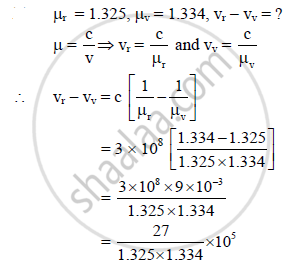
= [log (27) − log (1.325) − log (1.334)] × 105
= [1.4314 − 0.1222 − 0.1252] × 105
= [antilog (1.184)] × 105
= 15.28 × 105 = 1.528 × 10⁶ m/s.
The difference between the velocities of rays for red and violet colours in water is
1.528 × 10⁶ m/s.
APPEARS IN
RELATED QUESTIONS
Draw a neat labelled diagram showing the plane of vibration and plane of polarisation for polarised light.
If the critical angle of a medium is sin-1(3/5), find the polarising angle.
Three identical polaroid sheets P1, P2 and P3 are oriented so that the pass axis of P2 and P3 are inclined at angles of 60° and 90° respectively with the pass axis of P1. A monochromatic source S of unpolarised light of intensity I0 is kept in front of the polaroid sheet P1 as shown in the figure. Determine the intensities of light as observed by the observer at O, when polaroid P3 is rotated with respect to P2 at angles θ = 30° and 60°.

Show, using a simple polaroid, that light waves are transverse in nature. Intensity of light coming out of a polaroid does not change irrespective of the orientation of the pass axis of the polaroid. Explain why.
Show, with the help of a diagram, how unpolarised sunlight gets polarised due to scattering.
Two polaroids P1 and P2 are placed with their pass axes perpendicular to each other. Unpolarised light of intensity I0 is incident on P1. A third polaroid P3 is kept in between P1 and P2 such that its pass axis makes an angle of 60° with that of P1. Determine the intensity of light transmitted through P1, P2 and P3.
What is the Brewster angle for air to glass transition? (Refractive index of glass = 1.5)
When a low flying aircraft passes overhead, we sometimes notice a slight shaking of the picture on our TV screen. Suggest a possible explanation.
A ray of light passes from a vacuum to a medium of refractive index (μ). The angle of
incidence is found to be twice the angle of refraction. The angle of incidence is _______.
A) `cos^(-1)(mu/2)`
B) cos−1(μ)
C) `2 cos^(-1) (mu/2)`
D) `2 sin^(-1) (mu/2)`
Unpolarised light is passed through a polaroid P1. When this polarised beam passes through another polaroid P2 and if the pass axis of P2 makes angle θ with the pass axis of P1, then write the expression for the polarised beam passing through P2. Draw a plot showing the variation of intensity when θ varies from 0 to 2π.
What does a polaroid consist of? How does it produce a linearly polarised light?
A beam of light is incident at the polarizing angle of 35° on a certain glass plate. The refractive index of the glass plate is :
A ray of light is incident on a transparent medium at a polarizing angle. What is the angle between the reflected ray and the refracted ray?
Greenlight is an incident at the polarising angle on a certain transparent medium. The angle of refraction is 30°.
Find
(i) polarising angle, and
(ii) refractive index of the medium.
What is polarisation?
What is plane polarised light?
What is unpolarised light?
What is partially polarised light?
List the uses of polaroids.
What is normal focusing?
Polarisation of light is the only phenomenon that establishes ______.
Which of the following phenomena is not common to sound and light waves?
For the same objective, find the ratio of the least separation between two points to be distinguished by a microscope for light of 5000 Å and electrons accelerated through 100 V used as the illuminating substance.
Figure shown a two slit arrangement with a source which emits unpolarised light. P is a polariser with axis whose direction is not given. If I0 is the intensity of the principal maxima when no polariser is present, calculate in the present case, the intensity of the principal maxima as well as of the first minima.

