Advertisements
Advertisements
प्रश्न
The refractive indices of water for red and violet colours are 1.325 and 1.334 respectively.
Find the difference between the velocities of rays for these two colours in water. (c = 3 × 10⁸ m/s)
Advertisements
उत्तर
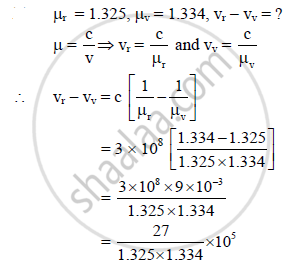
= [log (27) − log (1.325) − log (1.334)] × 105
= [1.4314 − 0.1222 − 0.1252] × 105
= [antilog (1.184)] × 105
= 15.28 × 105 = 1.528 × 10⁶ m/s.
The difference between the velocities of rays for red and violet colours in water is
1.528 × 10⁶ m/s.
APPEARS IN
संबंधित प्रश्न
If the polarising angle for a given medium is 60°, then the refractive index of the medium is.................
For a glass plate as a polariser with refractive index 1.633, calculate the angle of incidence at which light is polarised.
Show, using a simple polaroid, that light waves are transverse in nature. Intensity of light coming out of a polaroid does not change irrespective of the orientation of the pass axis of the polaroid. Explain why.
Using the phenomenon of polarisation, show how the transverse nature of light can be demonstrated.
Show, via a suitable diagram, how unpolarised light can be polarised by reflection.
What is the value of refractive index of a medium of polarising angle 60°?
Show using a proper diagram how unpolarised light can be linearly polarised by reflection from a transparent glass surface.
With the help of an experiment, state how will you identify whether a given beam of light is polarised or unpolarized?
State any two methods by which ordinary light can be polarised
A ray of light is incident on a transparent medium at a polarizing angle. What is the angle between the reflected ray and the refracted ray?
What is the difference between polarised light and unpolarised light?
Explain how an unpolarised light gets polarised when incident on the interface separating the two transparent media.
Greenlight is an incident at the polarising angle on a certain transparent medium. The angle of refraction is 30°.
Find
(i) polarising angle, and
(ii) refractive index of the medium.
What is a polariser?
What is a analyser?
State and obtain Malus’ law.
State Brewster’s law.
Discuss about pile of plates.
What is double refraction?
The reflected light is found to be plane polarised when an unpolarized light falls on a denser medium at 60° with the normal. Find the angle of refraction and critical angle of incidence for total internal reflection in the denser to rarer medium reflection.
A plane mirror produces a magnification of
Polarisation of light is the only phenomenon that establishes ______.
Which of the following phenomena is not common to sound and light waves?
Can reflection result in plane polarised light if the light is incident on the interface from the side with higher refractive index?
To ensure almost 100 per cent transmissivity, photographic lenses are often coated with a thin layer of dielectric material. The refractive index of this material is intermediated between that of air and glass (which makes the optical element of the lens). A typically used dielectric film is MgF2 (n = 1.38). What should the thickness of the film be so that at the center of the visible spectrum (5500 Å) there is maximum transmission.
A polarizer - analyser set is adjusted such that the intensity of light coming out of the analyser is just 10% of the original intensity. Assuming that the polarizer - analyser set does not absorb any light, the angle by which the analyser need to be rotated further to reduce the output intensity to be zero, is ______.
