Advertisements
Advertisements
Question
The rate of photosynthesis is not affected by
Options
light intensity
humidity
temperature
CO2 concentration
Advertisements
Solution
humidity
RELATED QUESTIONS
Complete the following by filling in the blanks numbered 1 to 10 with the appropriate word/term:
Photosynthesis involves light reaction and dark reaction. During light reaction, the chlorophyll present in the (1) ______ gets activated by absorbing light energy. This energy splits (2) ______ molecules to (3) ______ and oxygen and releases two electrons. This process is called (4) ______. The (5) ______ ions are picked up by NADP to form (6) ______. The ADP is converted to (7) ______. This process is called (8) ______. During the dark phase, the compound produced at the end of the light reaction reacts with carbon dioxide to form (9) ______. This product is converted to starch. The process is called (10) ______.
Choose the correct answer:
In a typical leaf, photosynthesis occurs mainly in ___________
During photosynthesis, the oxygen in glucose comes from
Explain, why respiration is said to be a reversed process of photosynthesis?
What is the law of limiting factors?
Give technical term:
The part of the chloroplast where the dark reaction of photosynthesis takes place.
What is photosynthesis and wherein a cell does occur?
Arrange and rewrite the terms in the group in the correct order to be in a logical sequence beginning with the term that is underlined:
Snake, Rabbit, Cabbage, Hawk.
Study the diagram given below and fill in the blanks with suitable words:
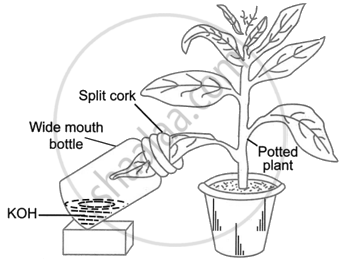
In order to prove that carbon dioxide is necessary for
(a) ______, a potted plant is placed in dark for 48 hours to (b) ______ the leaves. A part of a leaf is inserted into a conical flask containing potassium hydroxide solution. This is to absorb (c) ______ from the flask. The plant is then placed in sunlight for a few hours. The experimental leaf is tested for starch. The part of the leaf that was inside the conical flask turns (d) ______, whereas the part of the left outside turns (e) ______ in colour.
