Advertisements
Advertisements
Question
The primary coil having NP turns of an ideal transformer is supplied with an alternating voltage VP. Obtain an expression for the voltage VS induced in its secondary coil having NS turns.
Advertisements
Solution

For the simple transformer shown in the figure, the output voltage VS depends almost entirely on the input voltage VP and the ratio of the number of loops in the primary and secondary coils. Faraday's law of induction for the secondary coil gives its induced output voltage VS to be
`V_S = -N_S((Deltaphi)/(Deltat))` .....(i)
Where NS is the number of loops in the secondary coil and `(Deltaphi)/(Deltat)` is the rate of change of magnetic flux.
The cross-section area of the coils is the same on either side, as is the magnetic field strength, and so `(Deltaphi)/(Deltat)` is the same on either side. The input primary voltage VP is also related to changing flux by
`V_P = -N_P(Deltaphi)/(Deltat)` .....(ii)
Lenz's law tells us that the primary coil opposes the change in flux caused by the input voltage VP hence the minus sign is given.
Dividing both the equation, we get
`V_S/V_P = N_S/N_P`
`V_S = V_P(N_S/N_P)`
APPEARS IN
RELATED QUESTIONS
Explain the construction and working of the transformer.
Which coil of a step up transformer is made thicker and why?
The following diagram in Fig.10.42 shows a coil of several turns of copper wire connected to a sensitive centre zero galvanometer G near a magnet NS. The coil is free to move in the direction shown in the diagram.
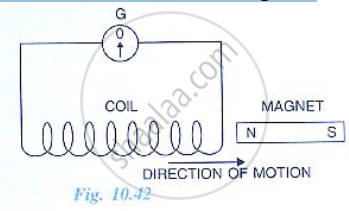
(i) Describe the observation if the coil is rapidly moved.
(ii) How would the observation be altered if (a) the coil has twice as many turns (b the coil was made to move three times as fast?
A transformer is designed to work from a 240 V a.c. mains and to give a supply of 8 V to ring a house bell. The primary coil has 4800 turns. How many turns will be in the secondary coil?
What is a transformer? On what principle does it work?
A transformer lowers e.m.f. from 220 V to 15 V. If the number of turns in primary are 3520, how many turns are in the secondary coil?
Find out the phase relationship between voltage and current in a pure inductive circuit.
A 100% efficient transformer has 100 turns in the primary and 50 turns in its secondary coil. If the current in the secondary coil is 6 A, then the current in the primary coil is ______.
An ideal transformer converts 170 V a.c. to 1.70 KV a.c. to transmit a power of 3.4 KW. If primary coil has 500 turns then alternating current in secondary coil is ______.
How is the laminated soft iron core made?
