Advertisements
Advertisements
Question
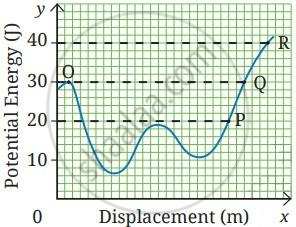
The potential energy-displacement graph of a 0.5 kg ball moving along a frictionless track is shown in the Fig. At O, the velocity of the ball is 0 m s–1 and potential energy is 30 J. Calculate the velocity of the ball at P, Q and R.
Advertisements
Solution
Given,
Mass (m) = 0.5 kg
At O, velocity = 0 m s–1 and potential energy = 30 J
So, kinetic energy at O = 0 J
Total mechanical energy = Kinetic energy + Potential energy = 0 + 30 = 30 J
The whole mechanical energy (30 J) is conserved at every location since the track is frictionless.
At any point, Kinetic energy = Total mechanical energy – Potential energy
At P (potential energy = 20 J):
Kinetic energy = 30 – 20 = 10 J
`1/2 "mv"^2 = 10`
`1/2 xx 0.5 xx v^2 = 10`
v2 = 40
`v = sqrt(40) = 2sqrt(10) ≈ 6.3 "m s"^-1`
At Q (potential energy = 30 J):
Kinetic energy = 30 – 30 = 0 J
v = 0 m s–1
The ball briefly stops at Q and then turns around.
At R (potential energy = 40 J):
Kinetic energy = 30 – 40 = –10 J
The ball cannot go to point R because kinetic energy cannot be negative. The ball turns back before it reaches R because the potential energy at R (40 J) is higher than the ball's total mechanical energy (30 J).
Hence, the velocity at P is about 6.3 m s–1, at Q is 0 m s–1, and the ball does not reach R.
