Advertisements
Advertisements
Question
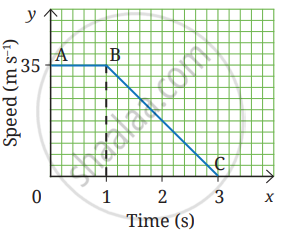
A 1000 kg car is moving along a road at a constant speed. Suddenly, the driver notices some obstruction ahead and applies the brakes to come to a complete stop. The graphical representation of motion of the car starting from the instant the driver spots the traffic ahead is shown in the Fig.
- Describe how the car moves between positions A and B.
- Calculate the kinetic energy of the car at A.
- State the work done by the brakes in bringing the car to a halt between B and C.
Advertisements
Solution
Given,
Mass of the car (m) = 1000 kg
From the graph (Fig. 7.38), the speed of the car between A and B is constant at 35 m s–1.
(i) The car's speed stays at 35 m s–1 between points A and B. This is the response time, the period of time before the driver uses the brakes during which the vehicle keeps moving steadily.
(ii) Kinetic energy of the car at A,
`K = 1/2 "mv"^2`
= `1/2 xx 1000 xx (35)^2`
= `1/2 xx 1000 xx 1225`
= 612500 J
Hence, the kinetic energy of the car at A = 612500 J.
(iii) The final kinetic energy is zero since the brakes completely stop the vehicle between B and C.
Work done by the brakes = Final KE – Initial KE = 0 – 612500 = –612500 J
Because the braking force opposes the velocity, the work performed by the brakes is therefore –612500 J (negative).
(iv) The car's kinetic energy is mostly converted into thermal energy in the tires and brakes, with a tiny amount going toward sound energy.
