Advertisements
Advertisements
Question
The plan and measurement for a house are given in the following figure. The house is surrounded by a path 1 m wide.

Find the following:
- Cost of paving the path with bricks at rate of ₹ 120 per m2.
- Cost of wooden flooring inside the house except the bathroom at the cost of ₹ 1200 per m2.
- Area of Living Room.
Advertisements
Solution

i. Area of path = Area of rectangle PQRS – Area of rectangle ADFH
= PQ × QR – AD × DF
= (4 + 2.5 + 4 + 1 + 1) × (3 + 3 + 1 + 1) – (4 + 2.5 + 4) × (3 + 3)
= 12.5 × 8 – 10.5 × 6
= 37 m2
∴ Cost of paving the path with bricks = Cost per unit m2 × Total area of path
= 120 × 37
= ₹ 4440
ii. Area of house except bathroom = Area of house – Area of bathroom
= Area of rectangle ADFH – Area of rectangle BCLK
= (4 + 2.5 + 4) × (3 + 3) – 2.5 × 2
= 63 – 5
= 58 m2
∴ Cost of flouring = Cost per unit m2 × Total area
= 1200 × 58
= ₹ 69600
iii. Area of living room = Area of rectangle ACGH – Area of rectangle ABJI – Area of rectangle BCLK
= (4 + 2.5) × (3 + 3) – 4 × 3 – 2.5 × 2
= 39 – 12 – 5
= 22 m2
APPEARS IN
RELATED QUESTIONS
The length of a rectangular park is 14 m more than its breadth. If the perimeter of the park is 200 m, what is its length? Find the area of the park
Find the area of the following rectangle
length = 7 m and breadth = 4 m
If length of a rectangle is halved and breadth is doubled then the area of the rectangle obtained remains same.
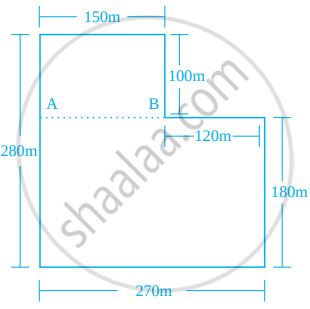
Divide the park shown in the following figure of question 40 into two rectangles. Find the total area of this park. If one packet of fertilizer is used for 300 sq m, how many packets of fertilizer are required for the whole park?
Find the area of the rectangle whose sides are:
2 km and 3 km
The area of a rectangular garden 50 m long is 300 sq m. Find the width of the garden.
Priyanka took a wire and bent it to form a circle of radius 14 cm. Then she bent it into a rectangle with one side 24 cm long. What is the length of the wire? Which figure encloses more area, the circle or the rectangle?
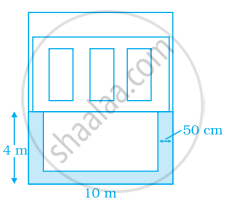
A 10 m long and 4 m wide rectangular lawn is in front of a house. Along its three sides a 50 cm wide flower bed is there as shown in the following figure. Find the area of the remaining portion.
Ramesh grew wheat in a rectangular field that measured 32 metres long and 26 metres wide. This year he increased the area for wheat by increasing the length but not the width. He increased the area of the wheat field by 650 square metres. What is the length of the expanded wheat field?
A rectangle has an area of 48 sq cm and breadth of 4 cm. What is its length?
