Advertisements
Advertisements
Question
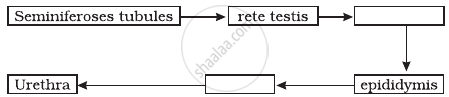
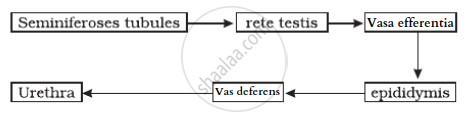
The path of sperm transport is given below. Provide the missing steps in blank boxes.
Advertisements
Solution
The path of sperm transport
APPEARS IN
RELATED QUESTIONS
Write the location and functions of the following in human testes :
Leydig cells
Identify True/False statement. Correct the false statement to make it true.
Leydig cells are found in the ovary.
Describe the T.S. of human testis
Given alongside is a diagram of male reproductive system in humans. Label the parts indicated by numbers 1 to 5, and state their functions.

Describe the male reproductive systems in humans.
Differentiate between primary and accessory reproductive organs.
Explain the Term Penis.
Name the Following
The male gamete (male reproductive cells) of mammals.
Give Technical Term:
In which organ of the male reproductive system maturation of sperms takes place?
Write the functional activity of the following structure:
Testis
How are the sperms formed?
How is the semen produced?
Identify the location of Leydig cells.
Select the MISMATCHED pair.
Spermatids are transformed into sperm by a process called ______.
Sketch and label Human Male Reproductive System.
Given below is a certain situation. Analyze and describe its possible impact on a person:
Testes of a male boy are not able to descend into the scrotum during his embryonic development.
The vas deferens is described as which type of duct?
Seminal plasma is rich in which three substances essential for sperm survival and motility?
