Advertisements
Advertisements
Question
The number of heterotrophs found in desert regions is smaller. However, they are found in greater numbers in the sea. Why is this so?
Advertisements
Solution
The conditions in deserts are extremely difficult for survival of organisms. Not all kinds of organisms can survive in such harsh climatic conditions, which means there are only few types of organisms which would be found in this region. Since, there are not many kinds of plants and animals which are found in this region, heterotrophs would not be able to survive and would die of starvation. That is why less heterotrophs are found in desert areas. However, in case of a habitat like sea, there are plenty of organisms which are found in the region ranging from aquatic plants, to small fishes to big fishes. It is an environment which supports the survival of heterotrophs, and thus more heterotrophs are found in this region.
RELATED QUESTIONS
What substances enter into the food vacuole in Amoeba to break down the food?
Name a unicellular animal which uses cilia to move food particles into it mouth.
What are the various types of heterotrophic nutrition?
Classify the following into herbivores, carnivores and omnivores:
Lion, Man, Dog, Goat, Crow, Elephant, Snake, Hawk, Rabbit, Deer
The correct order of steps occurring in nutrition in animals is:
| A unicellular animal P having no fixed shape ingests a food particle by forming temporary finger-like projections Q. The food particle is engulfed with a little surrounding water to form a temporary stomach R inside it. The chemicals S from surrounding cytoplasm enter into R and break down food into small and soluble molecules by chemical reactions. The digested food is absorbed directly into cytoplasm by the process T. The undigested food is thrown out of the body by the rupture of a cell organelle U in a process called V. |
- Name the unicellular animal P.
- What are (i) Q and (ii) R?
- Name (i) chemical S, and (ii) process T.
- Name (i) organelle U, and (ii) process V.
In the expriment of preparing a temporary mount of a leaf peel to observe stomata, we use two liquids other than water. Name these two liquids and state when and why these liquids are used.
In which mode of nutrition an organism derives its food from the body of another living organism without killing it?
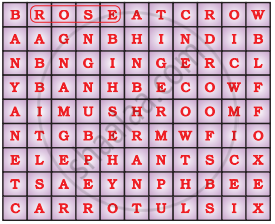
Spot as many organisms as possible in the puzzle given as Figure by encircling them as shown. Write the names on a sheet of paper and categorise them into autotrophs and heterotrophs. Classify the heterotrophs into herbivores, carnivores, omnivores and saprophytes.
Generally, food is broken and absorbed within the body of organisms. In which of the following organisms is it done outside the body?
