Advertisements
Advertisements
Question
Advertisements
Solution
If the sum of the measures of two angles is 90°, they are known as complementary angles.
(i) m∠B + m∠N
= 60° + 30°
= 90°
∴ ∠B and ∠N are complementary angles.
(ii) m∠Y + m∠E
= 90° + 0°
= 90°
∴ ∠Y and ∠E are complementary angles.
(iii) m∠D + m∠F
= 75° + 15°
= 90°
∴ ∠D and ∠F are complementary angles.
If the sum of the measures of two angles is 180°, they are known as supplementary angles.
(iv) m∠B + m∠G
= 60° + 120°
= 180°
∴ ∠B and ∠G are supplementary angles.
(v) m∠N + m∠J
= 30° + 150°
= 180°
∴ ∠N and ∠J are supplementary angles.
RELATED QUESTIONS
Find the supplementary angle of 70°
Find the supplementary angle of 35°
Find the supplementary angle of 0°
Find the supplementary/complementary angle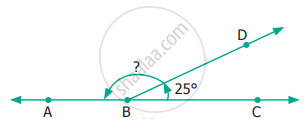
The angles x – 10° and 190° – x are ______.
The measure of an angle which is four times its supplement is ______.
Two angles forming a ______ pair are supplementary.
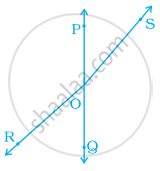
Name the pairs of supplementary angles in the following figure:
In the following figure, P, Q and R are collinear points and TQ ⊥ PR, name; two pairs of supplementary angles.
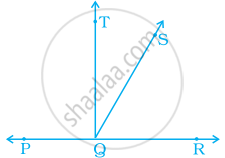
If two angles have a common vertex and their arms form opposite rays (Figure), Then, how many types of angles are formed?