Advertisements
Advertisements
Question
The line y = mx + 1 is a tangent to the curve y2 = 4x if the value of m is
(A) 1
(B) 2
(C) 3
(D) 1/2
Advertisements
Solution
The equation of the tangent to the given curve is y = mx + 1.
Now, substituting y = mx + 1 in y2 = 4x, we get:
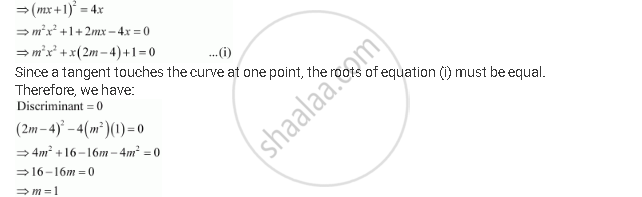
Hence, the required value of m is 1.
The correct answer is A.
APPEARS IN
RELATED QUESTIONS
Find the equation of the normal at a point on the curve x2 = 4y which passes through the point (1, 2). Also find the equation of the corresponding tangent.
Find the slope of the tangent to the curve y = 3x4 − 4x at x = 4.
Find points at which the tangent to the curve y = x3 − 3x2 − 9x + 7 is parallel to the x-axis.
Find the points on the curve y = x3 at which the slope of the tangent is equal to the y-coordinate of the point.
Find the equations of the tangent and the normal, to the curve 16x2 + 9y2 = 145 at the point (x1, y1), where x1 = 2 and y1 > 0.
Find the points on the curve y = `4x^3 - 3x + 5` at which the equation of the tangent is parallel to the x-axis.
Find the slope of the tangent and the normal to the following curve at the indicted point xy = 6 at (1, 6) ?
Find the values of a and b if the slope of the tangent to the curve xy + ax + by = 2 at (1, 1) is 2 ?
At what points on the curve y = x2 − 4x + 5 is the tangent perpendicular to the line 2y + x = 7?
Find the points on the curve \[\frac{x^2}{4} + \frac{y^2}{25} = 1\] at which the tangent is parallel to the x-axis ?
Who that the tangents to the curve y = 7x3 + 11 at the points x = 2 and x = −2 are parallel ?
Find the points on the curve y = x3 where the slope of the tangent is equal to the x-coordinate of the point ?
Find the equation of the tangent and the normal to the following curve at the indicated point \[x^\frac{2}{3} + y^\frac{2}{3}\] = 2 at (1, 1) ?
Find the equation of the tangent and the normal to the following curve at the indicated point x2 = 4y at (2, 1) ?
Find the equation of the tangent and the normal to the following curve at the indicated points x = θ + sinθ, y = 1 + cosθ at θ = \[\frac{\pi}{2}\] ?
Find the angle of intersection of the following curve x2 + y2 = 2x and y2 = x ?
Find the slope of the normal at the point 't' on the curve \[x = \frac{1}{t}, y = t\] ?
Write the slope of the normal to the curve \[y = \frac{1}{x}\] at the point \[\left( 3, \frac{1}{3} \right)\] ?
The equation of the normal to the curve y = x(2 − x) at the point (2, 0) is ________________ .
The angle between the curves y2 = x and x2 = y at (1, 1) is ______________ .
The equation of the normal to the curve 3x2 − y2 = 8 which is parallel to x + 3y = 8 is ____________ .
Find the equation of tangent to the curve y = x2 +4x + 1 at (-1 , -2).
Find the angle of intersection of the curves y2 = x and x2 = y.
The point on the curve y2 = x, where the tangent makes an angle of `pi/4` with x-axis is ______.
Find the condition that the curves 2x = y2 and 2xy = k intersect orthogonally.
Prove that the curves y2 = 4x and x2 + y2 – 6x + 1 = 0 touch each other at the point (1, 2)
If the curve ay + x2 = 7 and x3 = y, cut orthogonally at (1, 1), then the value of a is ______.
The two curves x3 – 3xy2 + 2 = 0 and 3x2y – y3 – 2 = 0 intersect at an angle of ______.
At (0, 0) the curve y = x3 + x
The points on the curve `"x"^2/9 + "y"^2/16` = 1 at which the tangents are parallel to the y-axis are:
The point on the curves y = (x – 3)2 where the tangent is parallel to the chord joining (3, 0) and (4, 1) is ____________.
The slope of the tangent to the curve x = a sin t, y = a{cot t + log(tan `"t"/2`)} at the point ‘t’ is ____________.
Find a point on the curve y = (x – 2)2. at which the tangent is parallel to the chord joining the points (2, 0) and (4, 4).
Find points on the curve `x^2/9 + "y"^2/16` = 1 at which the tangent is parallel to y-axis.
The number of common tangents to the circles x2 + y2 – 4x – 6x – 12 = 0 and x2 + y2 + 6x + 18y + 26 = 0 is
The normal at the point (1, 1) on the curve `2y + x^2` = 3 is
If the tangent to the conic, y – 6 = x2 at (2, 10) touches the circle, x2 + y2 + 8x – 2y = k (for some fixed k) at a point (α, β); then (α, β) is ______.
