Advertisements
Advertisements
Question
The label on the bottle of chemical is spoiled. How will you find whether the chemical is acidic or not?
Advertisements
Solution
The chemical is acidic or not checked in two ways:
- By use of litmus paper:
- If the given solution is acidic, it turns blue litmus to red litmus.
- If the given solution is basic, it turns red litmus to blue litmus.
- If the given solution is neutral, there is no effect on litmus paper.
- By use of indicators:
- If the given solution is acidic, it turns methyl orange to red.
- If the given solution is basic, it turns methyl orange to yellow.
- If the given solution is neutral, there is no effect on methyl orange indicator.
RELATED QUESTIONS
Three solutions P, Q and R have pH value of 3.5, 5.2 and 12.2 respectively. Which one of these is a:
- Weak acid?
- Strong alkali?
What happens to the H+ ions, of the solution, when an acid is neutralised?
Name an acid used to flavor and preserve food.
Write the balanced equations for the reaction required to convert insoluble lead (II) oxide into insoluble lead chloride.
If iron reacts with dilute sulphuric acid, what will be the products?
An aqueous solution turns red litmus solution blue. Excess addition of which of the following solutions would reverse the change?
Match the acids given in column (A) with their correct source given in column (B)
| Column (A) | Column (B) |
| (a) Lactic acid | Tamarind |
| (b) Acetic acid | Lemon |
| (c) Citric acid | Vinegar |
| (d) Tartaric acid | Curd |
When an acidic solution is mixed with a basic solution, they ______ each other forming ______ and water.
Fill in the cross word given in figure with the help of the clues provided.
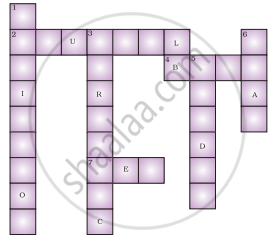
Across
(2) The solution which does not change the colour of either red or blue litmus.
(4) Phenolphthalein gives pink colour in this type of solution.
(7) Colour of blue litmus in lemon juice.
Down
(1) It is used to test whether a substance is acidic or basic.
(3) It is a natural indicator and gives pink colour in basic solution.
(5) Nature of ant’s sting.
(6) It is responsible for the increase in temperature during a neutralisation reaction.
Match the following:
| 1. | The hardest substance in our body | a. | Aluminum phosphate |
| 2. | Citrus fruits | b. | Potash alum |
| 3. | Rice plant | c. | Insoluble in water |
| 4. | Double salts | d. | Acidic soil |
| 5. | Silver chloride | e. | Calcium phosphate |
| f. | Alkaline soil |
