Advertisements
Advertisements
Question
The inner circumference of a circular track is 264 m and the width of the track is 7 m. Find:
(i) the radius of the inner track.
(ii) the radius of the outer circumference.
(iii) the length of the outer circumference.
(iv) the cost of fencing the outer circumference at the rate of ₹50 per m.
Advertisements
Solution
Inner circumference of the circular track = 264 m
(i) ∴ Inner radius (r) = `"C"/(2π)`
= `(264xx7)/(2xx22)=1848/44` = 42 cm
(ii) Width of the track = 7 m
∴ Outer radius (R) = 42 + 7 = 49 m
(iii) Outer circumference = 2πR
= `2xx22/7xx49` = 308 m
(iv) Rate of fencing = ₹50 per metre
∴ Total cost of fencing outer circumference = ₹50 × 308 = ₹15,400
APPEARS IN
RELATED QUESTIONS
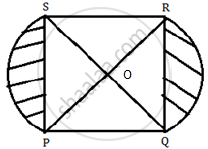
In the figure given below, PQRS is square lawn with side PQ = 42 metres. Two circular flower beds are there on the sides PS and QR with centre at O, the intersections of its
diagonals. Find the total area of the two flower beds (shaded parts).
Find the circumference of the circle with the following radius: (Take `bb(pi = 22/7`)
28 mm
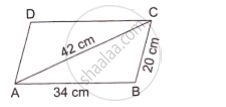
The adjacent sides of a parallelogram ABCD measure 34 cm and 20 cm, and the diagonal AC measures 42 cm. Find the area of the parallelogram.
The shape of the cross section of a canal is a trapezium. If the canal is 10 m wide at the top, 6 m wide at the bottom and the area of its cross section is 640 m2, find the depth of the canal.
The area of an equilateral triangle is `49sqrt(3)` cm2. Taking each angular point as centre, circles are drawn with radius equal to half the length of the side of the triangle. Find the area of the triangle not included in the circles. [Take `sqrt(3) = 1.73`.]
A wire when bent in the form of a square encloses an area of 484 cm2. If the same wire is bent into the form of a circle, find the area of the circle.
The diameter of a wheel is 1.4m. How many revolutions does make in moving a distance of 2.2km?
The diameter of a circular well is 4.2 m. What is its circumference?
In reference to a circle the value of π is equal to ______.
Circumference of a circle disc is 88 cm. Its radius is ______.
