Advertisements
Advertisements
Question
The initial pressure and volume of a given mass of a gas (Cp/Cv = γ) are p0 and V0. The gas can exchange heat with the surrounding. (a) It is slowly compressed to a volume V0/2 and then suddenly compressed to V0/4. Find the final pressure. (b) If the gas is suddenly compressed from the volume V0 to V0/2 and then slowly compressed to V0/4, what will be the final pressure?
Advertisements
Solution
Given:
For the gas, `("C"_"p")/"C"_"v" = gamma`
Initial pressure of the gas = P0
Initial volume of the gas = V0
(a)
(i) As the gas is slowly compressed, its temperature will remain constant.
For isothermal compression,
P1V1 = P2V2
So, P0V0 =P2 `"V"_0/2 =>"P"_2 = 2"P"_0`
(ii) Sudden compression means that the gas could not get sufficient time to exchange heat with its surroundings. So, it is an adiabatiac compression.
So, for adiabatic compression,
P1V1γ = P2V2γ Or
`2"P"_0 ("V"_0/2)^gamma = "P"_2 ("V"_0/4)^ gamma`
`=> "P"_2 = "V"_0^gamma/2^ gamma xx 2"P"_0 xx 4^gamma/"V"_0^gamma`
= 2γ × 2P0 = P02γ+1
(b)
(i) Adiabatic compression:
P1V1γ = P2V2γ
`"P"_0"V"_0 ^ gamma = "P'"("V"_0/2)^ gamma`
⇒ P' = P02γ
(ii) Isothermal compression:
P1V1 = P2V2
`2 ^ gamma "P"_0 xx "V"_0/2 = "P''" ("V_0/2)`
P" = P02γ × 2
⇒ P" = P02γ+1
APPEARS IN
RELATED QUESTIONS
From a certain apparatus, the diffusion rate of hydrogen has an average value of 28.7 cm3 s–1. The diffusion of another gas under the same conditions is measured to have an average rate of 7.2 cm3 s–1. Identify the gas
[Hint: Use Graham’s law of diffusion: R1/R2 = (M2/M1)1/2, where R1, R2 are diffusion rates of gases 1 and 2, and M1 and M2 their respective molecular masses. The law is a simple consequence of kinetic theory.]
If it were possible for a gas in a container to reach the temperature 0 K, its pressure would be zero. Would the molecules not collide with the walls? Would they not transfer momentum to the walls?
Explain why cooking is faster in a pressure cooker.
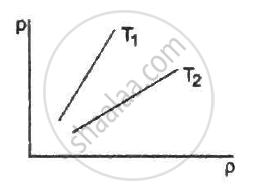
Figure shows graphs of pressure vs density for an ideal gas at two temperatures T1 and T2.
A container of volume 50 cc contains air (mean molecular weight = 28.8 g) and is open to atmosphere where the pressure is 100 kPa. The container is kept in a bath containing melting ice (0°C). (a) Find the mass of the air in the container when thermal equilibrium is reached. (b) The container is now placed in another bath containing boiling water (100°C). Find the mass of air in the container. (c) The container is now closed and placed in the melting-ice bath. Find the pressure of the air when thermal equilibrium is reached.
Use R = 8.3 J K-1 mol-1
Is a slow process always isothermal? Is a quick process always adiabatic?
In an adiabatic process on a gas with γ = 1.4, the pressure is increased by 0.5%. The volume decreases by about
A vessel of volume V0 contains an ideal gas at pressure p0 and temperature T. Gas is continuously pumped out of this vessel at a constant volume-rate dV/dt = r keeping the temperature constant. The pressure of the gas being taken out equals the pressure inside the vessel. Find (a) the pressure of the gas as a function of time, (b) the time taken before half the original gas is pumped out.
Use R = 8.3 J K−1 mol−1
Three samples A, B and C of the same gas (γ = 1.5) have equal volumes and temperatures. The volume of each sample is doubled, the process being isothermal for A, adiabatic for B and isobaric for C. If the final pressures are equal for the three samples, find the ratio of the initial pressures.
A barometer tube is 80 cm long (above the mercury reservoir). It reads 76 cm on a particular day. A small amount of water is introduced in the tube and the reading drops to 75.4 cm. Find the relative humidity in the space above the mercury column if the saturation vapour pressure at the room temperature is 1.0 cm.
The human body has an average temperature of 98°F. Assume that the vapour pressure of the blood in the veins behaves like that of pure water. Find the minimum atmospheric pressure which is necessary to prevent the blood from boiling. Use figure for the vapour pressures.
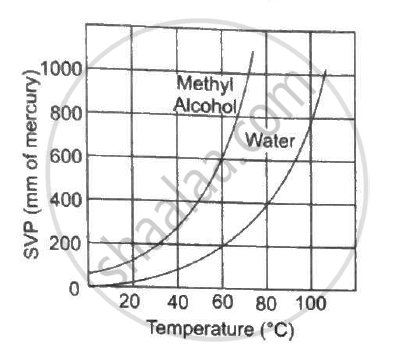
A faulty barometer contains certain amount of air and saturated water vapour. It reads 74.0 cm when the atmospheric pressure is 76.0 cm of mercury and reads 72.10 cm when the atmospheric pressure is 74.0 cm of mercury. Saturation vapour pressure at the air temperature = 1.0 cm of mercury. Find the length of the barometer tube above the mercury level in the reservoir.
The temperature and relative humidity in a room are 300 K and 20% respectively. The volume of the room is 50 m3. The saturation vapour pressure at 300 K 3.3 kPa. Calculate the mass of the water vapour present in the room.
Use R = 8.3 J K-1 mol-1
The temperature and the relative humidity are 300 K and 20% in a room of volume 50 m3. The floor is washed with water, 500 g of water sticking on the floor. Assuming no communication with the surrounding, find the relative humidity when the floor dries. The changes in temperature and pressure may be neglected. Saturation vapour pressure at 300 K = 3.3 kPa.
Use R = 8.31 J K-1 mol-1
If 1022 gas molecules each of mass 10-26 kg collide with a surface (perpendicular to it) elastically per second over an area of 1 m2 with a speed of 104 m/s, the pressure exerted by the gas molecules will be of the order of ______.
Air separated from the atmosphere by a column of mercury of length h = 15 cm is present in a narrow cylindrical two-soldered at one end. When the tube is placed horizontally the air occupies a volume V1 = 240 mm3. When it is set vertically with its open end upwards the volume of the air is V2 = 200 mm3. The atmospheric pressure during the experiment is 7n cm of Hg where n is a single digit number. n will be ______.
