Advertisements
Advertisements
Question
The human female gonads are ovaries. A maturing egg in the ovary is present in a sac of cells called ______ (1). As the egg grows larger, the follicle enlarges and gets filled with a fluid and is now called the ______ (2) follicle. The process of releasing the egg from the ovary is called ______ (3). The ovum is picked up by the oviducal funnel and fertilization takes place in the ______ (4). In about a weak the blastocyst gets fixed in the endometrium of the uterus and this process is called ______ (5).
Advertisements
Solution
The human female gonads are ovaries. A maturing egg in the ovary is present in a sac of cells called ovarian follicle (1). As the egg grows larger, the follicle enlarges and gets filled with a fluid and is now called the Graafian (2) follicle. The process of releasing the egg from the ovary is called ovulation (3). The ovum is picked up by the oviducal funnel and fertilization takes place in the ampulla (4). In about a weak the blastocyst gets fixed in the endometrium of the uterus and this process is called implantation (5).
RELATED QUESTIONS
Define the following term :
Ovulation
Choose the correct answer from the four options given below :
On which day of the menstrual cycle does ovulation take place ?
State the names of four hormones which control menstrual cycle.
Answer the following type of question Assertion (A) and Reason (R).
(A) - Ovulation is the release of the ovum from the Graafian follicle.
(R) - It occurs during the follicular phase of the menstrual cycle.
In the absence of fertilization, corpus luteum ____________.
The temporary endocrine gland in humans is ______.
In the figure given below, parts A and B show the level of hormones which influence the menstrual cycle. Study the figure and answer the questions that follow:
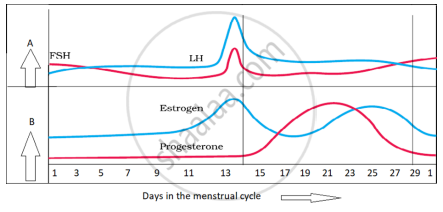
- Name the organs which secrete the hormones represented in parts A and B.
- State the impact of the hormones in part B on the uterus of the human female during 6 to 15 days of the menstrual cycle.
Which of the following statement is correct?
Spermatogenesis is induced by ______.
The onset of menstruation in a human female is called ______.
