Advertisements
Advertisements
Question
The hopping kangaroo is a familiar sight in every snapshot relating to Australia. Members of the kangaroo family can be as small as a rat or as big as a man. Kangaroos are found mainly in Australia, Tasmania and New Guinea. Kangaroos, which are big-footed marsupials that evolved in Australia, use their short front legs like arms. The man-sized kangaroos of Australia are capable of speeding up to 88 km/hr for short distances, their means of locomotion being their powerful hind legs, which carry them over the ground in jumps of 9 m or more at a time.
Weighing around 70 kg, they have an average lifespan of around six to eight years and a maximum lifetime of 20 years. When bothered by predators, kangaroos often head for the water, standing submerged to the chest and attempting to drown the attacker by holding him under water. Another defensive technique is to get their back to a tree and kick at their adversary with their clawed hind feet, sometimes with sufficient force to kill a man. Normally shy animals, they alert other kangaroos to danger by beating on the ground with their hind feet. This loud alarm signal carries over a long distance.
The tail is important for kangaroos. It holds them in balance and supports them when they sit or fight against other kangaroos. The kangaroo uses its short legs as arms. With them it scratches itself, cleans its fur and holds branches when it eats leaves. Kangaroos are marsupials and the females carry newborns in a pouch in front of their abdomens. The babies are born small and climb up into safety of the pouch. There, for the next 225 days or so, they eat, sleep and grow. Once they reach full development, they leave the pouch. A young kangaroo that leaves the pouch is called a ‘joey’. To keep from getting too hot, the kangaroos take naps in the afternoon and do most of their grazing at night. But the best stay-cool secret of these creatures is the spit bath! Kangaroos drool and lick saliva all over their faces and bodies to cool down.
On the basis of your reading of the above passage, complete the following sentences with appropriate words/phrases:
(a) When followed by predators, kangaroos submerge ____________ and _________________.
(b) The powerful hind legs help kangaroos to __________________.
(c) Kangaroos are mainly found in Australia and are ____________________.
(d) They use their front legs to ___________________.
(e) Kangaroos warn others of danger by _______________________.
(f) The secret of kangaroos to stay cool is ______________________.
(g) They use their tails to _________________________.
(h) Before becoming ‘joeys’, the young ones stay in the ______________ and ________________.
Advertisements
Solution 1
a) to the chest in water and attempt to drown the attackers by holding them under water
b) locomote over the ground and take jumps of 9 m or more at a time
c) big-footed marsupials
d) scratch themselves, clean their fur and hold branches when they eat leaves
e) beating the ground with their hind feet
f) the spit bath
g) hold them in balance and support them when they fight against other kangaroos
h) pouches in front of their mothers’ abdomens and eat, sleep and grow for 225 days or so
Solution 2
(a) themselves up to their chests and attempt to drown the attacker by holding him under water.
(b) carry themselves over the ground in jumps of 9 metres or more at a single time.
(c) also found in Tasmania and New Guinea.
(d) fulfil the functions of arms.
(e) beating on the ground with their hind feet.
(f) licking saliva all over their faces and bodies.
(g) support themselves when they sit or fight against other kangaroos.
(h) female kangaroo’s pouch, and for the next 225 days, they eat sleep and grow there.
APPEARS IN
RELATED QUESTIONS
B1. Choose
Choose the correct alternatives and complete the sentences (2)
(1) The narrator is :
(a) an astronaut
(b) an engineer studying in BITS Pilani
(c) in the team of astronauts.
(2) Armstrong said, 'That's one small step for a man, one giant leap for mankind which means:
(a) one step on the moon means, many steps on the earth.
(b) he felt like a giant on the moon.
(c) one moon mission had opened up many avenues in science and technology for mankind.
It was late evening of July 20. 1969, when we turned up the hostel radio. I was an engineering student at BITS, Pilani. I still remember the feverish excitement that gripped us from July 16 when Apollo 11. the US space rocket, took off from Cape Kennedy, Florida. Neil Armstrong and his team of astronauts, Edwin "Buzz" Aldrin and Michael Collins, were to land on moon, for the first time in human history. We listened 'with rapt attention when Armstrong declared: "That's one small step for a man, one giant leap for mankind."
His death on Saturday, August 25, is a moment to salute the romance of space science that Apollo 11 unleashed. It has changed forever the way we look at our planet Earth and its satellite, the moon.
Standing on powdery moondust, Armstrong put up his thumb, shut one eye and found his thumb blotting out the Earth. "It suddenly struck me that that tiny pea, pretty and blue, was the Earth” he said later. "I felt very, very small." But behind that humbling realisation stood a giant truth:
The effort to explore the universe united mankind in technology and knowledge. Each moon mission, about 110 till date, provided more confidence to take on bolder projects.
B2. Complete (2)
(1) Armstrong describes the earth as ……………
(2) The effort to explore the universe has ………………
(3) Apollo 11 unleashed and changed forever ………………
(4) The author came to know about Apollo 11 mission when he …………..
B3. Solve
Solve the crossword with the clues given below. Refer to the passage for your answers: (2)

Down : (1) The area beyond the earth's atmosphere .
(2) The name of the spacecraft that Armstrong travelled.
Across : (3) A person trained to travel in space.
(4) Y A natural satellite of the earth.
B4. Begin the sentence
(i) With-For the first time .......and rewrite [1]
Neil Armstrong, Edwin Aldrin and Michael Collins were, to land on the moon for the first time.
(ii) Insert 'that' appropriately and rewrite. [1]
Armstrong found his thumb blotting out the Earth.
B5. Personal Response
Would you like to be an astronaut? Give reasons.
1. Why does a person become overconfident? The reason lies in over assessment of his capabilities. Sometimes people over assess their competence and jump into situations that are beyond their control.
2. Napoleon Bonaparte who became Emperor of France would say that the word 'impossible' was common only amongst fools. The overconfident Napoleon invaded Russia in the winter of 1812. This proved to be a big disaster.
3. Overconfidence generally leads people into misadventures, endangering their chances in life. It is wisely said that any achievement is a result of two factorsone's personal planning and support from the external world. People, take into account only their planning, generally ignoring external factors. As a result they are unable to foresee future developments. Hence, a great risk of failure.
4. Then there is the question: how can one manage overconfidence? The formula is very simple. Before taking a decision discuss the matter with other informed people with an objective mind and when it is proved that you are about to go off the path, accept reality and say without delay, "I was wrong'.
5. Overconfidence is a flaw characterizing people who lack the virtue of modesty. Modesty makes you a realist; you become a person who is cut down to size. People of this kind become very cautious; before taking an action they assess the whole situation. They adopt a realistic approach.
6. Overconfident people live within their own thoughts. They know themselves but they are unaware of others. Living inside their own cell they are unable to make use of the experiences of others. This kind of habit is highly damaging to all concerned
7. There is a saying that the young man sees the rule and the old man sees the exception, with a slight change, I would like to say that the overconfident person sees the rule and the confident person sees the exception. Overconfident people are always at risk. It is said that taking risk is good but it must be well calculated otherwise it becomes very dangerous.
1) Answer the following :(8)
a. Why does a person become overconfident?
b. What does overconfidence generally lead people into?
c. How can one manage overconfidence?
d. What kind of person does 'modesty' make you?
2)Find meanings of the words given below with the help of the options that follow :(4)
a. Misadventure (Para 3)
(i) Mishap (ii) Unlucky (iii) Unhappy (iv) Unpleasant
b. Endangering (Para 3)
(i) Reckless (ii) Imperil (iii) Risky (iv) Threatening
c. Assess (Para 5)
(i) Assemble (ii) Acquire (iii) Evaluate (iv) Accept
d. Objective (Para 4)
(i) Obedient (ii) Servile (iii) Honest (iv) Impartial
Read the extract given below and answer the questions that follow :
When I got to New Mullion, my eager expectations of a sweet and simple country village were severely disappointed. Its streets were rivers of mud, with rows of wooden shops, either painted a sour brown, or bare of any paint at all.
(a) Who is 'I'?
(b) Why was 'I' disappointed?
(c) What does the word 'expectations' mean ?
Read the following extract and answer the questions given below:
We commemorate so many special days such as Republic Day, Independence Day, Mother's Day and so on. Well, here is one day that deserves not only a commemoration but our total dedication - Earth Day, 22 April. At Sanctuary, we live our lives like every day is Earth Day, but we all believe that it would be, fantastic to remind our relatives, friends, neighbours, teachers, and elders on this day that protecting Mother Earth can end up making us both happy and safe.
Will you do something this Earth Day? Here's a handy list of things you can do-
(1) Cut Consumption: Consume as little as possible on Earth Day. This 'is a day·when you ca!l Refuse (to buy new things), Repair and Reuse (old stuff), Recycle (what you cannot reuse), Reject (stuff that is toxic or dangerous to the environment) and Renew (your purpose and resolve to protect the planet).
(2) Cut Energy: (a) Ditch the old incandescent bulbs and shift to CFLs or LEDs (Google both to find out more). (b) Walk or use public transport, try not to use private cars to save fuel. Carpool. Cut down on trips. Use Skype· instead of traveling for meetings. (c) Switch off unnecessary gadgets. (don't just use the remote .... walk to the mains!).
(3) Cut Waste: Start a waste segregation system in your building, school or neighbourhood. Compost organic waste, sell what you can to the raddi-wallah and give him a small token of.. appreciation also for he is protecting your world. Collect unused papers from old notebooks and make new ones from them.
(4) Cut out plastic: Speak to at least five shopkeepers in your area and tell them you and your friends will only use their shops if they move away from wasteful plastic packaging, particularly thin plastic bags.
(1) What do you understand from this extract?
(2) What steps can we take to keep our environment clean?
(3) Why should we commemorate Earth Day?
(4) What is your opinion regarding shifting to CFLs or LEDs?
(5) Rewrite the following sentences in the ways instructed :
(i) Earth Day deserves a commemoration and our total dedication.
(Use 'not only - but also'.)
(ii) Start a Waste Segregation System in your building.
(Rewrite it beginning with 'Let'.)
(iii) You can sell waste to the raddi-wallah and give him a
small token of appreciation.
(Replace the modal auxiliary by another showing 'obligation'.)
(6) What do the following words in the extract mean?
(i) resolve
(ii) toxic
Read the following extract and answer the questions given below:
Questions :
(2) What sort of patients did the doctor have?
(3) What were the reasons for the doctor's indigestion?
(4) “A doctor should have a pleasing personality and good manners.” Do you agree? Explain.
(ii) unsewn
Read the following extract and answer the questions given below:
To read a lot is essential. It is stupid not to venture outside the examination 'set books' or the textbooks you have chosen for intensive study. Read as many books in English as you can., not as a duty but for pleasure. Do not close the most difficult books you find, with the idea of listing and learning as many new words as possible. choose what is likely to interest you and be sure in advance, that it is not too hard. You should not have to be constantly looking up new words in the dictionary, for that deadens interest and checks real learning. Lookup a word here and there, but as a general policy try to push ahead. guessing what words mean from the context. It is extensive and not intensive reading that normally helps you to get interested in extra reading and thereby improve your English. You should enjoy the feeling which extensive reading gives. As you read, you will become more and more familiar with words and sentence patterns you already know, understanding them better and better as you meet them in more and more contexts, some of which may differ only slightly from others.
Some people say that we cannot learn to speak a language better with the help of a book. To believe that the spoken language and written language are quite different things. This is not so.
Questions:
(1) What does the author tell us about the importance of reading English?
(2) What different steps are suggested to improve reading?
(3) What do some people say about learning the spoken form of a language?
(4) What will you do to improve your English?
(5) Rewrite the following sentences in the ways instructed:
i. To read a lot is essential.
(Rewrite using gerund form of the words underlined.)
ii. Some people say that we cannot learn to speak a language better with the help of a book.
(Rewrite it using 'be able to'.)
iii. It is extensive.
(Make it a Rhetorical question.)
(6) You should not have to be constantly looking up new words in the dictionary, for that deadens interest and checks real learning.
The underlined word here means:
(i) develops
(ii) deprives of
(iii) creates
(B) Write a summary of the above extract with the help of the outline given below and suggest a suitable title.
Read a lot --- outside the textbooks --- for pleasure --- avoid difficult books ---read interesting ones --- avoid dictionary --- guess meanings --- extensive and not intensive reading --- different opinions.
Read the following extract and complete the table given below:
Children are perpetually asking questions. As adults, we are awkward with questions. We link the act of asking questions to ignorance. It indicates that we do not know; hence, we may look stupid while asking questions.
Children have no shame, whereas adults suffer from layers and layers of shame. Because children have no shame, they are more capable of failing at something and moving on from it. Our sense of shame makes us inhibited. So we do not try new things at work.
Children quickly make friends with strangers. Put two small kids alongside a few toys and they will start playing before they care to know about each other’s antecedents. As adults, we seek the false comfort of known relationships before we agree to play with each other.
Children freely express their emotions; adults learn to suppress their emotional side. We come to the workplace and are frequently counselled, “Do not get emotional.”
Children play. They find play in everything. Adults shun play and consider it the opposite of “serious work”. To a child, every act is an act of play.
Traits Delinking Childhood and Adulthood:
| Traits | Children | Adults | |
| 1 |
Asking Questions |
Perpetually ask questions freely |
(1) Feet awkward with questions (2) ___________ |
| 2 |
Feeling Shame |
(1) Feel no shame (2) ____________ |
(1) Suffer from shame (2) Inhibited to try new things at work |
| 3 |
Making friends |
(1) Quick in making friendship without knowing each other |
(1) ____________ |
| 4 |
Expressing emotions |
(1) ____________ |
(1) Suppress emotions. |
Read the following passage and do the activities.
A1. Complete the following sentences.
- Vegetarianism has not spread as desired because ______.
- Vegetarians are of various types ______.
|
Vegetarianism promotes a natural way of life. But despite its implicit message of universal love and nonviolence, it has not spread as it should have. This may be because it usually is an inward looking habit and is best cultivated in the mind. Leading a vegetarian way of life helps the animal kingdom to coexist with man. The animals supply milk, manure and energy. This has been central to Indian culture for thousands of years. A vegetarian lifestyle is natural, multifaceted and helps preservation in a healthy way. Food and health are closely related. Vegetarians are of various types. There are lacto-vegetarians who consume dairy products; Lacto-ovo-vegetarians include eggs in addition to dairy products. Vegans are pure vegetarians who do not consume any food derived from animals. The Western science of food considers food as something to sustain only the human body, whereas Indian science considers food as something which sustains not only the body, but also maintains the purity of heart, mind and soul. Thus, an item of food which is injurious to the mind is not considered to be fit for consumption, even if it is otherwise beneficial to the body or satisfies the taste. Indian food science does not give so much importance to protein or even to a balanced diet but it gives importance to food that increases the strength of the body and its vitality. Vegetarian foods provide an infinite variety of flavours whereas non-vegetarian foods have hardly any taste of their own. In fact, non-vegetarian foods have to be seasoned with ingredients from the vegetable kingdom to make them palatable. |
A2. What is the importance of eating vegetarian food?
A3.
- Pick out two adjectives from the given passage.
- Find words in the passage which mean the following:
- Indirect
- Tasty
A4. Convert the following sentence to negative without changing the meaning.
Leading a vegetarian way of life helps the animal kingdom to coexist with man.
A5. Why do you think vegetarianism is being promoted on a global level? Justify with your response.
Read the following passage and do the activities:
|
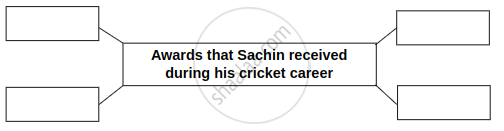
Sachin Ramesh Tendulkar who was born on 24th April 1973 in Mumbai is a former Indian International Cricketer and a former captain of the Indian National Team. He is regarded as one of the greatest batsmen of all time and is often referred as the ‘God of cricket’ by Indian Cricket followers. He made his debut on 15th November 1989 against Pakistan in ‘Karachi’ at the age of sixteen. He is the only player to have scored one hundred international centuries and only player to complete more than 30,000 runs in international cricket. He was trained under the able guidance of Ramakant Achrekar Sir. He received the Arjuna Award in 1994, Rajiv Gandhi Khel Ratna Award in 1997, Padma Shri and Padma Vibhushan Awards in 1999 and 2008 respectively, fourth and second highest civilian awards of India. He was also awarded the Bharat Ratna, highest civilian award of India in 2013. He is a devotee of the deity Ganesha. |
A1. Complete the following sentences from the passage: (2)
- Sachin was born on _____.
- Sachin is a devotee of the deity ______.
- He was trained under the able guidance of ______.
- He made debut on ______.
A2. Complete the web diagram: (2)
A3. Match the ‘Synonyms’: (2)
| ‘A’ | ‘B’ | ||
| i. | debut | a. | previous |
| ii. | received | b. | God |
| iii. | former | c. | got |
| iv. | deity | d. | first performance |
A4. Do as directed: (2)
- He made his debut. (Make ‘Simple Future Tense’.)
- He received the Arjuna Award. (Choose the correct Q-tag.)
- did he?
- didn’t he?
- doesn’t he?
A5. Do you like to play games? Why? (2)
