English

The given figure represents an experiment: Leaf A was coated with grease on both surfaces. Leaf B was coated with grease on the lower surface. Leaf C was coated with grease on the upper surface. - Biology

Advertisements
Advertisements

Question

The given figure represents an experiment:
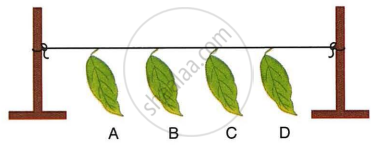
  1. Leaf A was coated with grease on both surfaces.
  2. Leaf B was coated with grease on the lower surface.
  3. Leaf C was coated with grease on the upper surface.
  4. Leaf D was left without any application of grease. All four leaves A, B, C and D were left in a room for about 24 hours.
    1. Which leaf dries first? Give reason.
    2. Which leaf dries last? Give reason.
Answer in Brief
Advertisements

Solution

  1. Leaf D: the leaf with no greasing on either surface would dry first, as it would shed the maximum amount of water from both surfaces.
  2. Leaf A: The leaf that was greased on both surfaces would dry out due to the fact that grease prevents water evaporation and transpiration by means of stomata, which are more prevalent on the lower surface of the leaf.
shaalaa.com
Kinds of Transpiration
  Is there an error in this question or solution?

RELATED QUESTIONS

Name the following:  

Any two parts of a leaf which allow transpiration.


Explain the mechanism of stomata?

The apparatus shown in the following diagram is Garreau’s potometer designed to demonstrate unequal transpiration from the two surfaces of a dorsiventral leaf. Before keeping the leaf in between the cups, anhydrous calcium chloride (CaCl2) contained in two small vials were weighed and placed in both the cups. The ends of the cups were closed with corks through which two mercury manometers were connected. After few hours, CaCl vials were taken out and weighed again.

What do you mean by transpiration?


How do stomata differ from a lenticel?


Give Reasons for the following:
Guard cells are small in size and are kidney-shaped in outline.


Draw a labeled diagram of the stomatal apparatus and label the following in it: Stoma, Guard cells, Chloroplast, Epidermal cells, and Cell wall.


Mark the most appropriate answer in the following:
 In the mechanism of opening and closing of stomata, the important factor is


Suppose you have a rose plant growing in a pot, how will you demonstrate transpiration in it?


Assertion (A): The loss of excess water from the aerial parts of the plant in the form of water vapor is known as transpiration.
Reason (R): Stomata of the leaf perform transpiration.


Given below is the figure of a stoma. Study the same and answer the following questions:

  1. Label the guidelines A and B.
  2. Write the exact location of the above-mentioned structures.
  3. Mention one important role of structure A.
  4. Write three important roles for structure B.
  5. Redraw the same figure when structures A are in flaccid condition. When does the flaccid condition occur?

Share
Notifications

Englishहिंदीमराठी


      Forgot password?
Use app×