Advertisements
Advertisements
प्रश्न
The given figure represents an experiment:
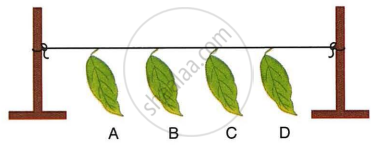
- Leaf A was coated with grease on both surfaces.
- Leaf B was coated with grease on the lower surface.
- Leaf C was coated with grease on the upper surface.
- Leaf D was left without any application of grease. All four leaves A, B, C and D were left in a room for about 24 hours.
- Which leaf dries first? Give reason.
- Which leaf dries last? Give reason.
Advertisements
उत्तर
- Leaf D: the leaf with no greasing on either surface would dry first, as it would shed the maximum amount of water from both surfaces.
- Leaf A: The leaf that was greased on both surfaces would dry out due to the fact that grease prevents water evaporation and transpiration by means of stomata, which are more prevalent on the lower surface of the leaf.
संबंधित प्रश्न
Name the following:
openings on the stem through which transpiration occurs.
Name the following:
Any two parts of a leaf which allow transpiration.
Given ahead is the diagram of an experimental set up to study the process of transpiration in plants. Study the same and then answer the questions that follow:

Is the experimental leaf a monocot or a dicot? Give a reason to support your answer.
Given ahead is the diagram of an experimental set up to study the process of transpiration in plants. Study the same and then answer the question that follow:

After about half an hour what change, if any, would you expect to find in the cobalt chloride paper placed on the dorsal and ventral sides of the leaf? Give a reason to support your answer.
The apparatus shown in the following diagram is Garreau’s potometer designed to demonstrate unequal transpiration from the two surfaces of a dorsiventral leaf. Before keeping the leaf in between the cups, anhydrous calcium chloride (CaCl2) contained in two small vials were weighed and placed in both the cups. The ends of the cups were closed with corks through which two mercury manometers were connected. After few hours, CaCl2 vials were taken out and weighed again.

What is the purpose of using a manometer?
Differentiate Between Cobalt chloride paper and Goat’s bladder.
The apparatus shown here is Girreau’s poto-meter designed to demonstrate unequal transpiration from the two surfaces of a dorsiventral leaf. Before keeping the leaf in between the cups, anhydrous calcium chloride (CaCl2) contained in two small vials were weighed and placed in both the cups. The ends of the cups were closed with corks through which two mercury manometers were connected. After a few hours, CaCl2 vials were taken out and weighed again.
(i) What is the purpose of keeping CaCl2 vials inside the cup?
(ii) After a few hours, the CaCl2 vials were taken out and weighed again. Will you expect any difference in weight? If so, give reasons.
(iii) What was the purpose of using a mano-meter?
(iv) What do you mean by transpiration?
Name the following:
The process of getting rid of excess water in the form of water vapour through the stomata.
Complete the following sentence with appropriate word:
Openings found on the undersurface of the dorsiventral leaf are ___________.
