Advertisements
Advertisements
Question
Attempt any TWO of the following:
‘The gene for sickle cell anaemia in homozygous condition is lethal and produces sickle cell trait in heterozygous carrier’. Explain.
Advertisements
Solution
Sickle cell trait describes a condition in which a person has one abnormal allellof the hemoglobin beta gene (is hetrozygous), but does not display the severe symptoms of sickle cell disese that occur in a person who has two copies of that allele (is hemozygous). Those who are heterozygous for the sickle cell allele produce both normal and abnormal hemoglobin (the two alleles are condominant with respect to the actual concentration of hemoglobin in the circulating cells).
Sickle cell disease is a blood disorder wherein there is a single amino acid substitution in the hemoglobin protein of the red blood cells which causes these cells to assume a sickle shape, especially when under low oxygen tension. Sickling and sickle cell disease also confer some resistance to malaria parasitization of red blood cells, so that individuals with sickle-cell trait (heterozygotes) have a selective advantage in environments where malaria is present.
APPEARS IN
RELATED QUESTIONS
A male rabbit of genotype 'AABBDDEE' is crossed with a female rabbit of genotype 'aabbddee' to produce F1 hybrid offspring. How many genetically different gametes can be produced by this F1 hybrid?
Which of the following characteristics are observed in a person suffering from Turner syndrome?
Sickel-cell anaemia is an example of ______.
Placed below is a karyotype of a human being.
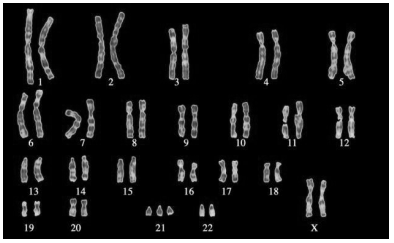
On the basis of this karyotype, which of the following conclusions can be drawn: ______
Read the following and answer from given below:
According to Mendel, one gene controls the expression of one character only. The ability of a gene to have multiple phenotypic effects because it influences a number of characters are an exception. The gene has multiple phenotypic effects because its ability to control two or more characters can be seen in cotton. In cotton, a gene for the lint also influences the height of the plant, size of the ball, number of ovules, and viability of seeds.
Which of the following disorder is an example of genes with multiple phenotypic effects?
Identify chromosomal disorder caused due to non-disjunction of the 21st number of chromosomes and enlist its symptoms.
Describe Klinefelter’s syndrome.
Match the disorder in column I with their nature in column II.
| Column I | Column II | ||
| i. | Thalassemia | a. | X monosomy |
| ii. | Turner’s syndrome | b. | Extra X chromosomes in male |
| iii. | Klinefelter’s syndrome | c. | 21st Trisomy |
| iv. | Down’s syndrome | d. | Mendelian disorder |
How many chromosomes are present in a normal human cell?
Which list contains only chromosomal disorders?
