Advertisements
Advertisements
प्रश्न
Attempt any TWO of the following:
‘The gene for sickle cell anaemia in homozygous condition is lethal and produces sickle cell trait in heterozygous carrier’. Explain.
Advertisements
उत्तर
Sickle cell trait describes a condition in which a person has one abnormal allellof the hemoglobin beta gene (is hetrozygous), but does not display the severe symptoms of sickle cell disese that occur in a person who has two copies of that allele (is hemozygous). Those who are heterozygous for the sickle cell allele produce both normal and abnormal hemoglobin (the two alleles are condominant with respect to the actual concentration of hemoglobin in the circulating cells).
Sickle cell disease is a blood disorder wherein there is a single amino acid substitution in the hemoglobin protein of the red blood cells which causes these cells to assume a sickle shape, especially when under low oxygen tension. Sickling and sickle cell disease also confer some resistance to malaria parasitization of red blood cells, so that individuals with sickle-cell trait (heterozygotes) have a selective advantage in environments where malaria is present.
APPEARS IN
संबंधित प्रश्न
Give an example of a human disorder that is caused due to a single gene mutation.
Write a note on Down’s syndrome.
Identify the characteristics that are observed in an individual suffering from Klinefelter syndrome.
i. Gynaecomastia, under developed testis and no spermatogenesis.
ii. Voice pitch is harsh.
iii. They are tall with long arms.
Match the Column-I with Column-II and choose the CORRECT answer
| Column-I | Column-II | ||
| P. | Klinefelter syndrome | i. | Mutation in autosomal gene |
| Q. | Thalassaemia | ii. | Mutation sex chromosome linked gene |
| R. | Down syndrome | iii. | Trisomy of autosome |
| S. | Colour blindness | iv. | Trisomy of sex chromosome |
HbA and HbS alleles of normal and sickle celled RBC are ______.
A disease caused by an autosomal primary non-disjunction is ______.
“Genes contain the information that is required to express a particular trait.” Explain.
Why is the frequency of red-green colour blindness is many times higher in males than that in females?
Jacob is genetically a carrier of the disorder that affects the shape of the RBCs, as shown in the diagram below. His son James suffers from the same disorder.
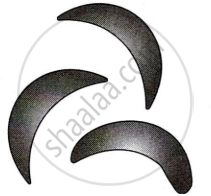
- Give the biochemical reason for the disorder that changes the shape of the RBCs, as shown above.
- Draw a Punnett square to show the genotype of the mother of James.
- Name and define the type of 'point mutation' responsible for this disorder.
At what level does the defect occur in chromosomal disorders?
