Advertisements
Advertisements
प्रश्न
Identify ‘a’, ‘b’, ‘c’, ‘d’, ‘e’ and ‘f’ in the table given below:
| S. No. | Syndrome | Cause | Characteristics of affected individuals | Sex (male/female/both) |
| 1. | Down’s | Trisomy of 21 |
‘a’ |
‘b’ |
| 2. | ‘c’ | XXY | Overall masculine development | ‘d’ |
| 3. | Turner’s | 45 with XO |
‘e’ |
‘f’ |
Advertisements
उत्तर
| No | Syndrome | Cause | Characteristics of affected individuals |
Sex/Male/Femal e/Both |
| 1. | Down’s | Trisomy of 21 |
(i) Broad forehead (ii) Permanently open mouth, protruding and furrowed tongue and projecting lower lip. |
Both |
| 2. | Klinefelter’s | XXY | Overall masculine development | Male |
| 3. | Turner’s | 45 with XO |
(i) Poorly developed ovaries, webbed neck, broad chest with under developed breasts and below average intelligence. (ii) Body hair absent |
Female |
APPEARS IN
संबंधित प्रश्न
Why are thalassemia and haemophilia categorized as Mendelian disorders? Write the symptoms of these diseases. Explain their pattern of inheritance in humans.
Given below is the representation of amino acid composition not the relevant translated portion of β-chain of haemoglobin, related to the shape of human red blood cells

(a) Is this representation indicating a normal human or a sufferer from certain related genetic disease? Give reason in support of your answer.
(b) What difference would be noticed in the phenotype of the normal and the sufferer related to this gene?
(c) Who are likely to suffer more from the defect related to the gene represented the males, the females or both males and females equally? And why?
Answer the following question.
Both Haemophilia and Thalessemia are blood-related disorders in humans. Write their causes and the difference between the two. Name the category of genetic disorder they both come under.
Which of the following characteristics are observed in a person suffering from Turner syndrome?
Identify the disease caused by an autosomal primary non-disjunction.
Thalassemia and sickle cell anemia are caused due to a problem in globin molecule synthesis. Select the correct statement.
In sickle-cell anaemia, shape of RBCs under oxygen tension becomes ______.
The person with Turner’s syndrome has ______.
Jacob is genetically a carrier of the disorder that affects the shape of the RBCs, as shown in the diagram below. His son James suffers from the same disorder.
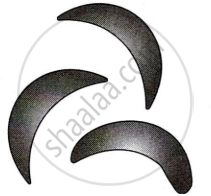
- Give the biochemical reason for the disorder that changes the shape of the RBCs, as shown above.
- Draw a Punnett square to show the genotype of the mother of James.
- Name and define the type of 'point mutation' responsible for this disorder.
What is the normal female karyotype?
