Advertisements
Advertisements
Question
The Frequency Polygon shown depicts the monthly rainfall in the Kathmandu (Nepal).
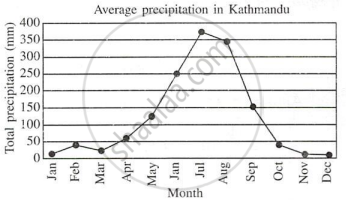
Answer the following:
- Which month had the highest rainfall?
- How many months had rainfall above 200 mm?
- How many months had rainfall below 100 mm?
- Calculate the Mean rainfall in the months from June to September.
Advertisements
Solution
(i)
By observing the highest peak on the frequency polygon, the maximum total precipitation occurs in July.
(ii)
Looking at the horizontal grid line for 200 mm, the points for June (250 mm), July (375 mm), and August (340 mm) are above this line. Thus, 3 months had rainfall above 200 mm.
(iii)
Looking at the horizontal grid line for 100 mm, the points that fall below it are January, February, March, April, October, November, and December. Thus, 7 months had rainfall above 100 mm.
(iv)
First, find the sum of the precipitation values for June, July, August, and September, and then divide by the number of months (4).
\[\text{Mean} = \frac{250 + 375 + 340 + 150}{4}\]
\[\text{Mean} = \frac{1115}{4}\]
∴ Mean = 278.75 mm
