Advertisements
Advertisements
Question
The data representing the number of people in municipalities in different towns is shown by the bar graph given below.
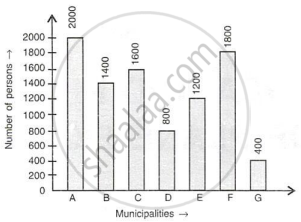
- What is the number of people living in municipality F?
- What is the total number of people living in municipalities A to C?
- What is the total population of all the municipalities under consideration?
- What the average (mean) of people living in municipalities B to E?
Case Study
Advertisements
Solution
(i)
Looking at the height of the bar for municipality F, the population is directly indicated above it. So, 1800 people live in municipality F.
(ii)
To find the total, add the populations of municipalities A, B, and C together.
Total = 2000 + 1400 + 1600 = 5000
(iii)
Sum the populations of all the given municipalities from A through G.
Total Population = 2000 + 1400 + 1600 + 800 + 1200 + 1800 + 400 = 9200
∴ Total Population = 9200
(iv)
First, find the sum of the populations for municipalities B, C, D, and E. Then, divide that sum by the number of municipalities in that range (which is 4).
\[\text{Mean} = \frac{1400 + 1600 + 800 + 1200}{4}\]
\[\text{Mean} = \frac{5000}{4} = 1250\]
∴ Mean = 1250
shaalaa.com
Is there an error in this question or solution?
