Advertisements
Advertisements
Question
The following diagram represents a mammalian kidney tubule (nephron) and its blood supply.
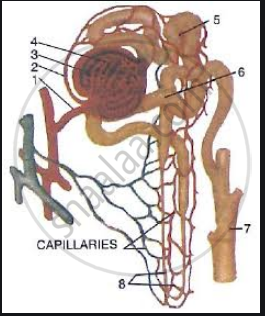
Parts indicated by the guidelines 1to 8 are as follows:
1. Afferent arteriole from renal artery
2. Efferent arteriole
3. Bowman's capsule
4. Glomerulus
5. Proximal convoluted tubule with blood capillaries
6. Distal convoluted tubule with blood capillaries
7. Collecting tubule
8. U-shaped loop of Henle
Study the diagram and answer the question that follow:
Where is most water reabsorbed ?
Advertisements
Solution
5/ Proximal convoluted tubule with blood capillaries
RELATED QUESTIONS
Explain Selective reabsorption
What does the bladder in our body do?
Fill in the blank.
Malpighian body consists of Bowman’s capsule and .....................
Differentiate between
excretion and transpiration
Given below is a set of five terms. Rewrite the terms in their correct order so as to be in logical sequence.
Afferent arteriole, renal vein, secondary capillary network, glomerulus, efferent arteriole.
Write down the functional activity of the following parts,
Henle's loop ………………
Choose the correct answer:
A condition of failure of kidney to form urea is called ____________
Differentiate between:
Ureter and Urethra.
Write the functional activity of the following structure: Renal artery
Complete the diagram/chart with correct labels/ information. Write the conceptual details regarding it.